
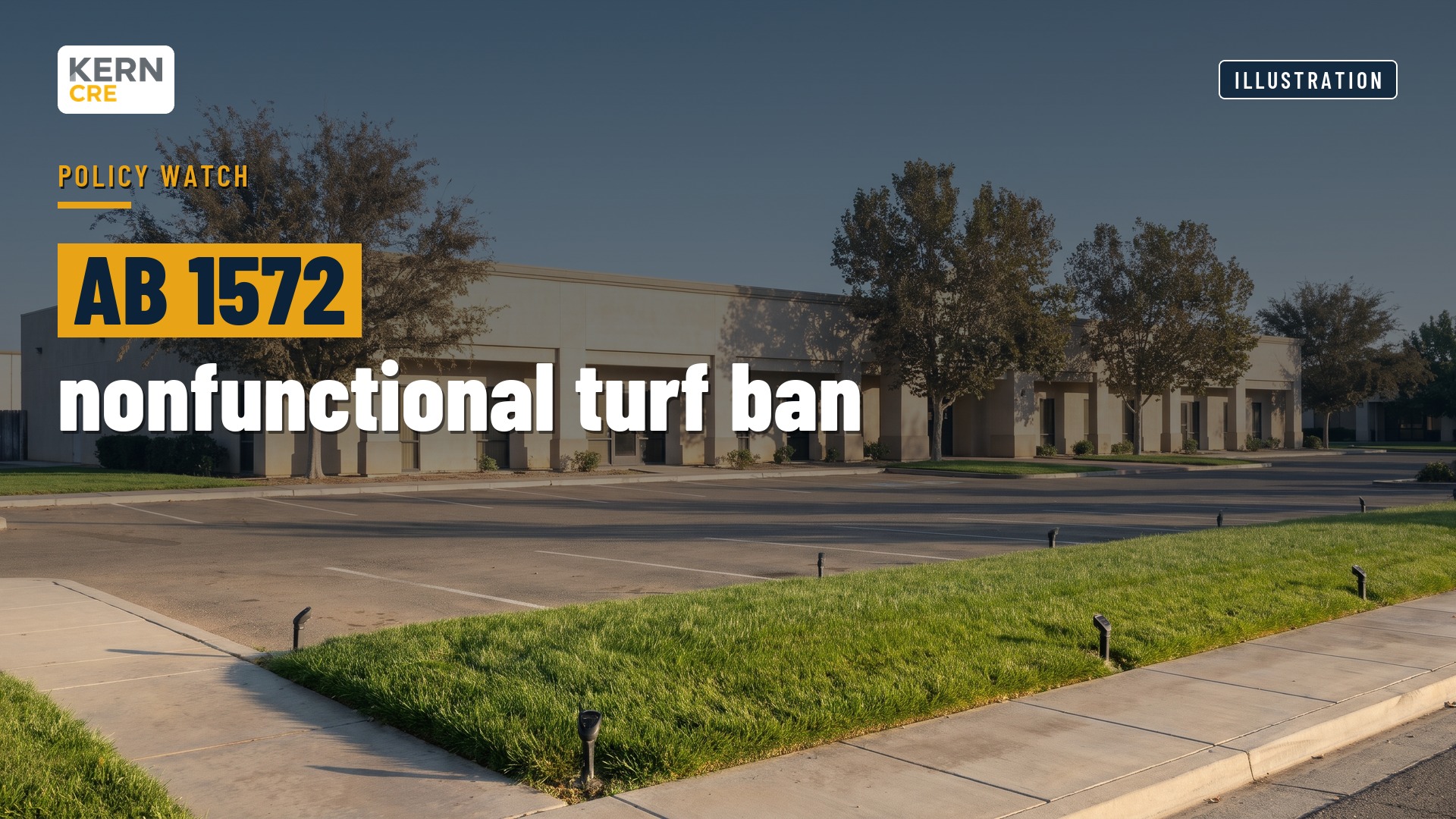
Starting Jan. 1, 2028, businesses in California can no longer water ornamental grass with drinking water. Here is what counts as nonfunctional turf, who enforces the ban and how to plan the conversion and its cost.
AB 1572 nonfunctional turf rules, signed by Gov. Gavin Newsom on Oct. 13, 2023 (Chapter 849, Statutes of 2023), bar using potable water to irrigate decorative grass. Commercial, industrial and institutional properties must stop by Jan. 1, 2028, after public properties in 2027 and before HOA common areas in 2029. Water suppliers, cities and counties can enforce it, and larger irrigated sites must self-certify compliance starting in 2030.
AB 1572 at a glance
| Item | Detail |
|---|---|
| Law | Assembly Bill 1572 (Friedman), Chapter 849, Statutes of 2023; adds Water Code section 110 and amends sections 10540, 10608.12 and 10608.22 |
| Signed | Oct. 13, 2023; effective Jan. 1, 2024 |
| What it bans | Using potable (drinking) water to irrigate nonfunctional turf |
| Commercial, industrial, institutional | Ban applies starting Jan. 1, 2028 |
| Other dates | Public properties Jan. 1, 2027; HOA common areas and community service organizations Jan. 1, 2029; public properties in disadvantaged communities Jan. 1, 2031 (tied to state funding) |
| Certification | Properties with 5,000 SF or more of irrigated area self-certify every three years; commercial, industrial and institutional properties first file by June 30, 2030 (per Cal Water) |
| Not covered | Single-family homes, parks, sports fields, cemeteries, recycled-water irrigation; trees may still be watered |
| Enforced by | Public water systems, cities and counties; violators face civil liability and penalties |
| Status | In law; the ban for business properties starts Jan. 1, 2028 |
Key takeaways
- AB 1572 (Chapter 849, Statutes of 2023) prohibits irrigating nonfunctional turf with potable water at commercial, industrial and institutional properties beginning Jan. 1, 2028.
- Turf in parking lots and street rights-of-way is nonfunctional by definition, so parking-lot islands and parkway strips at Kern business parks are squarely covered.
- Owners do not have to remove turf under AB 1572. They must stop watering it with potable water, though trees in turf areas may still be irrigated.
- Properties with 5,000 square feet or more of irrigated area must self-certify compliance every three years. Commercial, industrial and institutional filings are first due June 30, 2030, according to Cal Water.
- Cal Water offers a $1 per square foot rebate for turf conversions at commercial and other non-single-family properties, on a first-come, first-served basis.
What is AB 1572 and why did California pass it?
Assembly Bill 1572, by Assemblymember Laura Friedman, was signed on Oct. 13, 2023, according to an Aleshire & Wynder client update. It became Chapter 849 of the Statutes of 2023 and took effect Jan. 1, 2024. The policy statement sits in new Water Code section 110. It calls using potable water to irrigate nonfunctional turf “wasteful and incompatible with state policy relating to climate change, water conservation, and reduced reliance on the Sacramento-San Joaquin Delta ecosystem.”
The law is a phase-out, not an immediate ban. It sets separate start dates for public property, business property, homeowner association (HOA) common areas and properties in disadvantaged communities. It also amends the Water Code’s urban water management and conservation provisions (sections 10540, 10608.12 and 10608.22) so the ban fits into the state’s water-efficiency framework.
What counts as AB 1572 nonfunctional turf?
Nonfunctional turf is any turf that is not functional turf, and it expressly includes turf in street rights-of-way and parking lots. Cal Water’s summary defines functional turf as the groundcover surface of turf in a recreational use area or community space. Fenced areas that block human access do not qualify.
At a typical Kern County industrial or retail property, the grass in parking-lot islands, the parkway strip along the street, the decorative lawn at the building entry and the turf around monument signs are nonfunctional. A lawn genuinely used for employee recreation or community events may be functional, but owners should document that use.
- Not affected: single-family residential yards, parks, sports fields and cemeteries, according to Cal Water. Aleshire & Wynder also lists golf courses.
- Not affected: turf irrigated with recycled water, because the ban applies only to potable water.
- Allowed: watering trees, including within tree canopies, and irrigation to address an immediate health and safety need.
- Not required: removing turf. The law prohibits irrigating it with potable water, and replacement is optional.
Multifamily properties sit in a gray area. Cal Water includes multifamily and HOA areas in its rebate and its 2031 certification date. A statewide AB 1572 webinar Q&A sheet posted at nonfunctionalturfca.org says complexes of more than four units fall in the commercial, industrial and institutional category. Water suppliers apply the rules to their own customers.
When does the AB 1572 nonfunctional turf ban take effect?
For commercial, industrial and institutional properties, the ban starts Jan. 1, 2028. The dates below come from Cal Water’s AB 1572 guidance and match a Best Best & Krieger legal alert dated Feb. 26, 2026.
AB 1572 compliance and certification timeline
| Property type | Potable irrigation of nonfunctional turf prohibited from | First self-certification due (5,000+ SF irrigated) |
|---|---|---|
| State and local government properties, public schools, water systems (outside disadvantaged communities) | Jan. 1, 2027 | June 30, 2029 |
| Commercial, industrial and institutional (CII) properties | Jan. 1, 2028 | June 30, 2030 |
| HOA common areas and community service organizations | Jan. 1, 2029 | June 30, 2031 (Cal Water lists multifamily and HOA areas) |
| Public properties in disadvantaged communities | Jan. 1, 2031 (or when state funding is available) | Per State Water Board guidance |
After the first filing, certification repeats every three years, according to Cal Water. The State Water Resources Control Board (State Water Board) is directed to create the certification form. Aleshire & Wynder notes that CII owners over 5,000 square feet must self-certify to the board beginning in 2030.
Who enforces the turf ban, and what are the penalties?
According to Best Best & Krieger, “public water systems, as well as cities and counties” may enforce the restrictions. Aleshire & Wynder quotes the statute’s penalty language: “Noncompliance by a person or entity shall be subject to civil liability and penalties.” Water suppliers typically start with notices and warnings, but owners should not assume leniency once 2028 arrives.
The ban also sits inside the State Water Board’s “Making Conservation a California Way of Life” regulation, which took effect Jan. 1, 2025, according to the State Water Board’s FAQ. Best Best & Krieger reports that urban retail water suppliers must submit an AB 1572-compliant ordinance as part of their reporting under that regulation. That gives local suppliers their own reasons to adopt and enforce turf rules.
The same regulation reaches business customers in other ways. Suppliers must classify commercial, industrial and institutional water users into 22 categories. For landscapes of half an acre or more on mixed-use meters, they must install dedicated irrigation meters or use in-lieu technologies and offer best management practices. Owners of larger Kern business parks should expect more outreach, metering changes and landscape audits from their supplier, separate from AB 1572 itself.
How does AB 1572 play out in Bakersfield and Kern County?
Enforcement will come from whichever agency supplies the property’s water. Bakersfield-area properties are served by several suppliers, including Cal Water and city or district systems. The retail supplier named on the water bill sets the turf ordinance and rebate terms that apply.
Cal Water’s AB 1572 page says it offers $1 per square foot to agencies, multifamily properties, HOA common areas and commercial, industrial and institutional properties that convert turf to low-water landscaping, first-come, first-served. Customers of other suppliers, including the City of Bakersfield, fall under those suppliers’ own turf rules and rebate programs.
Water policy in Kern is under pressure from several directions at once, including groundwater sustainability plans under the Sustainable Groundwater Management Act and the Kern River litigation. Cutting irrigation demand on business properties is one of the few changes owners control directly. It can also lower operating costs that NNN tenants pay through CAM.
What does the turf ban mean for owners, tenants and CAM?
Owners have two compliance paths. They can stop irrigating the turf with potable water and let it go dormant or remove it, or they can convert it to drought-tolerant plants, mulch and drip irrigation. Dead turf may conflict with a city’s property maintenance standards, a project’s conditions of approval or a shopping center’s CC&Rs (covenants, conditions and restrictions) and lease commitments about appearance, which can rule out the low-cost path.
Conversion is usually a capital project. Whether its cost can be passed through to tenants depends on the lease. Many NNN and CAM clauses exclude capital improvements, allow them only if amortized, or allow them when required by law or when they reduce operating costs. AB 1572 compliance may fit a “required by law” clause, but the language controls. Our guides to operating expense pass-throughs and CAM reconciliations explain how these clauses usually work, and our lease structure guide covers who pays what under NNN, modified gross and full-service leases.
Timing matters. Landscape design, permits for irrigation changes, rebate applications and contractor schedules all take time, and spring is the practical planting window before Kern’s summer heat. Owners who want the work done before Jan. 1, 2028 should budget in 2026 and build in early 2027.
AB 1572 compliance checklist for Kern business properties
- Identify your retail water supplier and get its AB 1572 ordinance, enforcement approach and rebate terms in writing.
- Map every turf area and classify it as functional or nonfunctional. Photograph and document any recreational or community use.
- Measure total irrigated area to see whether the 5,000 SF certification threshold applies.
- Check whether any irrigation already uses recycled water, which is outside the ban.
- Review conditions of approval, CC&Rs, city landscape standards and lease clauses before letting turf go dormant.
- Decide on conversion, budget it and confirm CAM recoverability under each lease.
- Apply for rebates before construction, and keep trees on separate irrigation so they survive the change.
- Calendar Jan. 1, 2028 (ban) and June 30, 2030 (first CII certification).
Worked example: a Bakersfield business park with 12,000 SF of turf (illustrative)
Assume a multi-tenant industrial park in Bakersfield with 12,000 SF of irrigated turf. Of that, 7,000 SF is parking-lot islands and street parkway, and 5,000 SF is entry lawn that no one uses for recreation. All of it is watered with potable water from Cal Water. These figures are illustrative.
All 12,000 SF is nonfunctional: the parking-lot and right-of-way turf by definition, and the entry lawn because it is not a recreational use area or community space. Starting Jan. 1, 2028, none of it can be irrigated with potable water. Because irrigated area exceeds 5,000 SF, the owner must also self-certify, first by June 30, 2030 under Cal Water’s schedule.
If the Cal Water rebate is still funded when the owner applies, converting all 12,000 SF could earn up to $12,000 at $1 per square foot. The owner would compare contractor bids against that rebate and the expected water savings, then work out whether each lease lets the net cost be amortized through CAM.
Illustrative timeline for the 12,000 SF example
| Step | Target date |
|---|---|
| Inventory turf, gather supplier rules and rebate terms | Fourth quarter 2026 |
| Design, bids, rebate pre-approval, lease review | First quarter 2027 |
| Conversion and irrigation changes | Spring 2027 |
| Potable irrigation of nonfunctional turf must stop | Jan. 1, 2028 |
| First self-certification | June 30, 2030 |
Frequently asked questions
What is nonfunctional turf under AB 1572?
It is any turf that is not functional turf, and it expressly includes turf in street rights-of-way and parking lots. Functional turf is grass in a recreational use area or community space that people can actually use. Decorative lawns at building entries, parking-lot islands and parkway strips at commercial and industrial properties are the typical examples.
When does the turf ban apply to commercial and industrial properties?
Jan. 1, 2028. From that date, commercial, industrial and institutional properties may not irrigate nonfunctional turf with potable water. Public properties come first, on Jan. 1, 2027, and HOA common areas and community service organizations follow on Jan. 1, 2029. Public properties in disadvantaged communities have until Jan. 1, 2031 or until state funding is available.
Do I have to rip out my grass to comply with AB 1572?
No. The law bars watering nonfunctional turf with potable water but does not require removal. You can stop irrigating, switch to recycled water where it is available, or convert to low-water landscaping. City maintenance rules, conditions of approval, CC&Rs and lease clauses on landscaping and appearance may still apply to dead turf.
Can I still water trees that are planted in turf?
Yes. The law allows irrigation needed to keep trees healthy, and Cal Water lists areas under tree canopies among the exemptions. Irrigation for an immediate health and safety need is also allowed. If you convert turf, put the trees on separate drip or bubbler lines so they keep getting water after the lawn sprays shut off.
Who has to certify compliance with the turf ban?
Properties with 5,000 square feet or more of irrigated area must self-certify every three years, using a form the State Water Board is directed to create. Cal Water gives the first due dates as June 30, 2029 for public agencies, June 30, 2030 for commercial, industrial and institutional properties and June 30, 2031 for multifamily and HOA areas.
Are there turf replacement rebates in Bakersfield?
Cal Water, one of the suppliers serving the Bakersfield area, advertises $1 per square foot for commercial, industrial, institutional, multifamily and HOA turf conversions, first-come, first-served. Customers of other local water agencies fall under those agencies’ own programs. Rebate terms vary, and funding can run out.
Can a landlord charge tenants for turf conversion under AB 1572?
It depends on the lease. Many commercial leases exclude capital improvements from CAM or allow them only when amortized, when required by law or when they reduce operating costs. A turf conversion done to comply with AB 1572 may fit a required-by-law clause, but the exact wording controls.
If you own or lease a business property in Kern County and want to think through AB 1572 timing, budgets and lease implications, Kern CRE can help you frame the questions for your landscape contractor, water supplier and attorney. Call Kern CRE at 855-KERN-CRE (855-537-6273) or contact us.
Get Kern County CRE news monthly: subscribe to the Kern CRE report.
Sources
- Nonfunctional Turf Rules (AB 1572), California Water Service (Cal Water).
- AB 1572: Restrictions on Irrigation of Nonfunctional Turf, Aleshire & Wynder, LLP.
- Non-Functional Turf Ban: Compliance Deadlines and Action Steps for Public Water Systems, Best Best & Krieger LLP, Feb. 26, 2026.
- California Water Code section 110, Justia, 2025 code.
- Making Conservation a California Way of Life Regulation: Frequently Asked Questions, State Water Resources Control Board, Sept. 26, 2025.
- AB 1572 Webinar Q&A Sheet, nonfunctionalturfca.org, November 2025.
About this article
Kern CRE prepared this article with help from AI research and writing tools. An editor reviewed the draft, checked its facts against the sources linked above and edited it for accuracy and clarity. It is general information, not legal advice; confirm requirements with your water supplier and review lease and CC&R obligations with an attorney before making changes.