
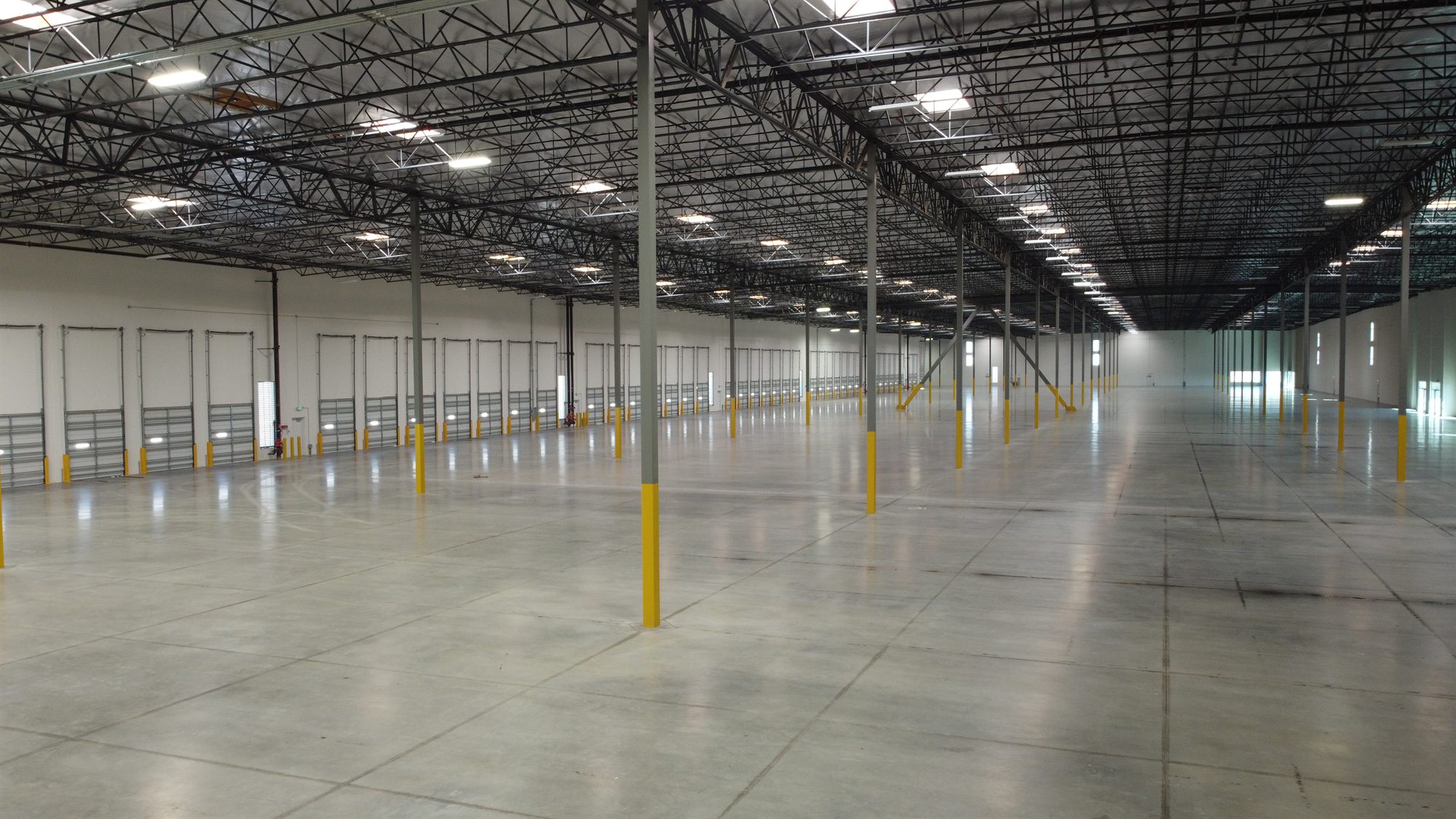
What ESFR sprinklers do, what California’s high-piled storage rules require, and how Kern County tenants and owners can avoid a fire permit surprise after the lease is signed.
An ESFR sprinkler system warehouse setup uses large, fast-acting ceiling sprinklers designed to suppress a fire, usually without in-rack sprinklers. In California, storing combustibles more than 12 feet high (6 feet for high-hazard goods) across more than 500 square feet, aisles included, also requires a high-piled storage permit from the fire department, whatever sprinkler system the building has.
Key takeaways
- ESFR sprinklers are designed to suppress a warehouse fire from the ceiling. That usually eliminates in-rack sprinklers and, under the California Fire Code, the smoke and heat removal requirement.
- The 2025 California Fire Code requires an operational permit for more than 500 square feet of high-piled combustible storage, and the 500 square feet includes aisles.
- Every ESFR system is designed for a specific commodity class, storage height and ceiling height. The hydraulic sign at the riser tells you what those are.
- ESFR needs at least 36 inches between the sprinkler deflectors and the top of storage, which sets your real stacking height.
- Kern County Fire covers unincorporated Kern and nine contract cities. Bakersfield Fire covers the City of Bakersfield.
What is an ESFR sprinkler system?
ESFR stands for early suppression, fast response. It is a ceiling sprinkler designed to knock a warehouse fire down while it is still small, rather than hold it in check until firefighters arrive. NFPA 13, the national sprinkler standard, describes suppression as sharply reducing the fire’s heat release and preventing regrowth.
ESFR heads combine a fast-response heat element with very large orifices (K-14 through K-28 are common) that drive heavy droplets down into the storage. Designed correctly, they usually protect tall rack storage from the ceiling alone, without the in-rack sprinklers that forklifts tend to damage.
The hydraulic design is different too. An ESFR system is calculated to flow 12 sprinklers at once (four on each of three branch lines) at the minimum pressure in the sprinkler’s listing. Those demands are high, so the water supply and any fire pump are central to the design.
How does ESFR compare with other warehouse sprinkler approaches?
| Approach | Goal | How it is designed | Typical warehouse fit |
|---|---|---|---|
| CMDA (control mode density/area) | Control the fire | A water density applied over a design area using NFPA 13 criteria | Older or lower-storage buildings; taller storage may need in-rack sprinklers |
| CMSA (control mode specific application) | Control the fire | A set number of large-drop sprinklers at a minimum pressure | Storage where ESFR does not fit; can be used in wet, dry or preaction systems |
| ESFR (early suppression, fast response) | Suppress the fire | 12 sprinklers flowing at a listed minimum pressure, with 36 inches minimum clearance to storage | Tall, flat-roofed distribution buildings; generally wet-pipe systems only |
What counts as high-piled combustible storage in California?
High-piled storage is combustible material stacked more than 12 feet high, or more than 6 feet for high-hazard goods. The California Fire Code (Title 24, Part 9) sets the rules. The 2025 edition took effect Jan. 1, 2026 and is based on the 2024 International Fire Code. Chapter 32 defines high-piled combustible storage as combustible materials in closely packed piles, on pallets, in racks or on shelves where the top of storage is more than 12 feet high. For high-hazard commodities, such as many Group A plastics, the trigger drops to 6 feet.
“Combustible” covers more than people expect. Even noncombustible products count once they sit on wood pallets or in corrugated cartons. The commodity class drives both the permit requirements and the sprinkler design, and protection must match the highest-hazard commodity you store.
Commodity classes in plain English
These are summaries of the classes in NFPA 13 and CFC Chapter 32. An engineer classifies your actual goods.
| Class | What it generally includes | Common example |
|---|---|---|
| Class I | Noncombustible products on wood pallets, in ordinary corrugated cartons or wrapped as a unit load | Canned food in cartons on wood pallets |
| Class II | Class I products in slatted wood crates, solid wood boxes or multiple-thickness paperboard cartons | Metal parts in wood crates |
| Class III | Wood, paper, natural-fiber cloth or Group C plastics, with only limited Group A plastic content | Paper goods, empty corrugated boxes, cotton textiles |
| Class IV | Class I to III products with an appreciable amount of Group A plastics in the product or packaging, plus Group B plastics | Mixed consumer goods with plastic parts or packaging |
| Group A plastics and high-hazard | Plastics with high heat release, expanded foam and other goods with special hazards; aerosols, flammable liquids and batteries have added rules | Foam products, plastic housewares, tires |
When is a high-piled storage permit required?
A permit is required once a building holds more than 500 square feet of high-piled storage, aisles included. Section 105.5.24 of the 2025 California Fire Code calls for an operational permit to use such a building. Section 105.6.14 calls for a construction permit to install or modify a structure with that much storage, which in practice means your rack installation. The section numbers come from GoCodebook’s online text of the 2025 code.
Batteries have their own trigger: an operational permit for more than 15 cubic feet of lithium-ion or lithium metal batteries (Sections 105.5.29 and 320). Larger indoor battery storage areas need a technical report, 2-hour fire barriers, sprinklers and specialized detection, so e-commerce and equipment distributors should raise this early.
Do you still need a high-piled storage permit if the building has ESFR?
Yes. ESFR describes the sprinkler design, while the permit approves your specific use: what you store, how high, in what racks and with what aisles. An “ESFR building” was designed for a particular commodity class, storage height and ceiling height. If your goods or layout fall outside that design, the fire department can require changes before it signs off.
Where ESFR helps is smoke and heat removal. Table 3206.2 calls for it in larger high-piled storage areas, but Section 910.2 exempts areas protected by ESFR sprinklers. Some agencies still require mechanical smoke removal for firefighting, and San Bernardino County Fire’s standard says so.
What does the fire department review on a high-piled storage plan?
Plans must show the storage layout, the sprinkler details and the access features. Section 3201.3 lists what goes on the plans, and the Kern County Fire Department’s permit handout repeats it. Expect to show:
- Location and dimensions of each high-piled storage area, with storage heights and rack tiers
- Clearance between the top of storage and the sprinkler deflectors
- Aisle widths, pile volumes and transverse and longitudinal flue spaces
- Commodity locations and classifications, including banded or encapsulated loads
- Fire department access doors, sprinkler and detection system types, and control valve locations
- Smoke removal and curtain board details, where applicable
Will you need a fire protection engineer?
For anything beyond simple storage, plan on it. Riverside County Fire requires one to evaluate the commodities and set the sprinkler design criteria, and San Bernardino County Fire requires an engineer’s stamped report for high-hazard and Group A plastic storage.
Approvals follow the operator and layout. Kern County Fire describes the high-piled permit as a use permit renewed annually, and San Bernardino County Fire says approved plans do not transfer to new tenants or subtenants. If you are taking over a racked building, assume you need your own permit. The Kern County handout cites the 2019 California Fire Code and an older fee, and the department’s fees, permits and applications page lists current forms and fees.
Which Chapter 32 rules shape a warehouse floor plan?
Chapter 32 adds physical requirements that scale with the size of the high-piled area and the commodity class. These most often change a rack layout or a building choice.
| Requirement | General rule | Why it matters |
|---|---|---|
| Aisle width | At least 44 inches in sprinklered buildings and 96 inches in nonsprinklered buildings, with exceptions | Forklift aisles are wider anyway, but shelving and pick areas can hit the minimum |
| Rack flue spaces | Transverse flues between loads (commonly 3 inches) and a longitudinal flue in double-row racks (commonly 6 inches) | Flues let heat reach the sprinklers and water reach the fire; pallet stops keep them open |
| Fire department access doors | Where required: at least 3 feet by 6 feet 8 inches, reachable without a ladder, no more than 125 feet apart | Dock-high doors without stairs generally do not qualify, so ground-level doors matter |
| Fire apparatus access | Fire access roads within 150 feet of all portions of the exterior walls | Affects fencing and yard layouts |
| Smoke and heat removal | Required for larger high-piled areas, except in areas protected by ESFR (Section 910.2) | Local agencies may still require mechanical smoke removal |
| Clearance to sprinklers | Shown on plans; ESFR requires at least 36 inches below the deflectors | Sets your real maximum stacking height |
The flue space figures come from a Riverside County Fire guideline that summarizes the code’s flue table, so treat them as common values rather than the code’s exact wording.
Where do ESFR systems hit their limits?
ESFR is powerful but unforgiving. These conditions most often force a redesign or a different system:
- Ceiling height. NFPA 13’s standard ceiling-only ESFR criteria have topped out at a 45-foot ceiling, according to a 2019 Risk Logic article. Some listed sprinklers and FM Global guidance go higher; otherwise in-rack sprinklers come back.
- Roof slope. ESFR is built for flat roofs. The 2025 edition of NFPA 13 requires a design area 50% larger (18 sprinklers instead of 12) or another option when the ceiling slope exceeds 2 in 12, per the National Fire Sprinkler Association. California may enforce an earlier NFPA 13 edition, and an engineer can say which one applies to a given building.
- Obstructions. ESFR spray patterns are sensitive to ducts, lights, deep beams and conveyors. Adding a mezzanine or conveyor under ESFR usually means added sprinklers.
- Freezers. ESFR is generally listed for wet-pipe systems, so freezer rooms needing dry or preaction piping usually need a different design. That matters for ag cold storage users in Delano, Shafter and Arvin, and our guide to cold storage and ag-industrial facilities in Kern County covers the building side.
- Commodities and shelving. Solid shelves, open-top containers, aerosols, flammable liquids and some exposed plastics can fall outside ceiling-only ESFR protection.
- Water supply. If the existing pump or water supply cannot meet your storage’s demand, upgrades become a major cost and schedule item.
How should tenants and owners check a building before signing?
Start with documents, then put your findings in writing. Sprinkler design is one of the specs in our guide to industrial building specs that matter, and it belongs on your due diligence checklist.
- Read the riser signs. NFPA 13 requires a hydraulic design sign at the riser stating, among other items, the commodity classification and maximum storage height the system was designed for.
- Get the records. Ask for sprinkler shop drawings, hydraulic calculations, the latest water flow test and recent inspection reports.
- Describe your inventory in writing. List products, packaging, pallet type, plastic and battery content and planned storage heights so an engineer can classify the commodity.
- Price any gap before you sign. Options include different heads, a fire pump, in-rack sprinklers or simply storing lower.
- Put it in the LOI and lease. In the AIR CRE single-tenant net lease form filed with the U.S. Securities and Exchange Commission in 2021, the tenant acknowledges it was advised to satisfy itself about the fire sprinkler system and the premises’ suitability for its use. Current AIR forms may word this differently. If the lease is silent, use-driven upgrades usually fall on the tenant. A permit contingency and cost split can be negotiated in the letter of intent.
Who is the fire code official for Kern County warehouses?
It depends on the parcel, not the mailing address. Inside Bakersfield city limits, the Bakersfield Fire Department’s Prevention Services reviews fire code permits through the city’s online portal; see the city’s fire prevention resources. The Kern County Fire Department covers unincorporated Kern, including Tejon Ranch, Lebec and Mojave, plus nine contract cities: Arvin, Delano, Maricopa, McFarland, Ridgecrest, Shafter, Taft, Tehachapi and Wasco. Its fees, permits and applications page lists current forms.
Some properties with a Bakersfield mailing address sit in unincorporated county pockets, so jurisdiction follows the parcel. The fire marshal’s interpretation is final, and local amendments can be stricter than the base code summarized here.
Example: a 40,000 SF Bakersfield warehouse with ESFR
A distributor is looking at a 40,000-square-foot building in the City of Bakersfield with 32 feet of clear height and an ESFR system. It plans selective pallet rack for cartoned housewares with significant plastic content. The figures below are hypothetical; an engineer would use the actual drawings.
| Step | Figure | What it tells you |
|---|---|---|
| High-piled area (racks plus aisles) | 16,000 SF of rack + 12,000 SF of aisles = 28,000 SF | Well above the 500 SF trigger: operational permit, plus a construction permit for the racks |
| Sprinkler deflector height | About 31 feet (assumed) | Deflectors hang below the roof structure |
| ESFR clearance | 31 feet minus 3 feet (36 inches) | Top of storage no higher than about 28 feet |
| Riser sign design basis | Assume it reads Class IV commodities to 25 feet | Group A plastics or storage above 25 feet may not be covered |
| Access doors | About 800 linear feet of exterior wall (200 x 200 building); 800 / 125 = 6.4 | Roughly seven qualifying doors, if the code requires building access here |
The result: the tenant either stores plastic-heavy products within the system’s design, or the parties agree on an engineered upgrade before signing. Learning this in permit review, after the racks are ordered, is the expensive way. For help sizing the space itself, see our guide on how much warehouse space you need.
Frequently asked questions
What does ESFR stand for?
ESFR stands for early suppression, fast response. These sprinklers open quickly and discharge large, heavy droplets to put out a warehouse fire from the ceiling, usually without in-rack sprinklers. NFPA 13 designs them to flow 12 sprinklers at a listed minimum pressure and requires storage to stay at least 36 inches below the deflectors.
When do I need a high-piled storage permit in California?
You need an operational permit when a building has more than 500 square feet of high-piled combustible storage, counting aisles, under the 2025 California Fire Code. High-piled means the top of storage is over 12 feet, or over 6 feet for high-hazard commodities. Installing or modifying racks that large also needs a construction permit.
Does an ESFR building mean I can store anything up to the roof?
No. Each ESFR system is designed for a maximum commodity class, storage height and ceiling height, and the sign at the riser states them. Storage must also stay 36 inches below the deflectors. Plastics, aerosols, flammable liquids, lithium batteries, solid shelving and freezers can all fall outside a standard design.
Who pays if the sprinkler system has to be upgraded for my inventory?
It is negotiable. In the AIR CRE form we reviewed, the tenant acknowledges it was told to check the sprinkler system and the building’s fit for its use. If the lease is silent, the cost often lands on the tenant. Settle it in the LOI and lease, and have a real estate attorney review the final wording.
Can ESFR sprinklers be used in a freezer or cold storage building?
Usually not inside the freezer itself. ESFR heads are generally listed for wet-pipe systems, and freezers need dry or preaction piping so the pipes do not freeze. Frozen rooms typically get a different design, sometimes with in-rack sprinklers or specially listed products. Bring in a fire protection engineer at the start of the project.
Does a high-piled storage permit transfer to the next tenant?
Do not count on it. The permit approves one operator’s commodities and layout. Kern County Fire treats it as a use permit renewed annually, and some California fire agencies say approved plans do not carry over to new tenants or subtenants. A new tenant, product line or rack layout typically means a new submittal.
Which fire department reviews high-piled storage in Kern County?
Bakersfield Fire Department’s Prevention Services handles permits inside city limits. Kern County Fire Department covers unincorporated areas plus Arvin, Delano, Maricopa, McFarland, Ridgecrest, Shafter, Taft, Tehachapi and Wasco. Jurisdiction follows the parcel, and the fire marshal sets local submittal rules and review times.
If you are weighing a Kern County warehouse and are not sure its sprinkler system fits your inventory, Kern CRE can help you gather the building’s sprinkler data early. Call Kern CRE at 855-KERN-CRE (855-537-6273) or contact us. Get Kern County CRE news monthly: subscribe to the Kern CRE report.
Sources
- California Building Standards Code (Title 24): 2025 edition effective Jan. 1, 2026, California Building Standards Commission.
- California Fire Code (CFC) 2025, Title 24 Part 9: edition overview (based on 2024 IFC), GoCodebook.
- 2025 CFC Section 105, Permits (105.5.24, 105.6.14, 105.5.29), GoCodebook.
- 2025 CFC Chapter 32, High-Piled Combustible Storage (definition), GoCodebook.
- 2025 CFC Section 3206, General Fire Protection and Life Safety Features (access doors, aisles, Table 3206.2), GoCodebook.
- 2025 CFC Section 910, Smoke and Heat Removal (910.2 exceptions including ESFR), GoCodebook.
- 2025 CFC Section 320, Battery Storage, GoCodebook.
- Permit Requirements: High-Piled Combustible Storage (handout), Kern County Fire Department.
- About KCFD (service area and contract cities), Kern County Fire Department.
- Commercial Hood and Clean Agent Application Form and Guidelines (electronic permit submittal, 2101 H Street), Bakersfield Fire Department, Prevention Services, January 2026.
- How to design fire sprinkler systems for high-piled storage, Consulting-Specifying Engineer (Patrick Veldenian, PE), July 2023.
- Explaining Fire Sprinkler Acronyms: ELO, ESFR and ECOH Sprinklers, QRFS (Phillip Dryden), January 2023, updated February 2026.
- The Basics of CMDA, CMSA, In-Rack, and ESFR Storage Sprinklers, QRFS (Phillip Dryden), September 2021, updated February 2026.
- A Guide to Fire Sprinkler Signs and System Marking in NFPA 13, QRFS (Jason Hugo), December 2017, updated January 2026.
- Changes in the 2025 Edition of NFPA 13 (TechNotes), National Fire Sprinkler Association (Roland Asp), July 2024.
- Ceiling-Only Sprinkler Designs for Warehouses with Ceiling Heights Over 45 ft., Risk Logic, September 2019.
- The ESFR trap, PHCP Pros (Samuel S. Dannaway), July 2015.
- High Piled Combustible Storage Guideline FP-03, Riverside County Fire Department, Office of the Fire Marshal, November 2023.
- Standard S-1: High Pile Combustible Storage, San Bernardino County Fire Protection District, July 2023.
- Standard Industrial/Commercial Single-Tenant Lease – Net, Paragraphs 2.3 and 2.4, AIR CRE (as filed with the U.S. SEC), 2021 filing.
About this article
Kern CRE prepared this article with help from AI research and writing tools. An editor reviewed the draft, checked its facts against the sources linked above and edited it for accuracy and clarity. It is general information, not legal, tax, investment or financial advice; talk with a qualified professional about your situation.