
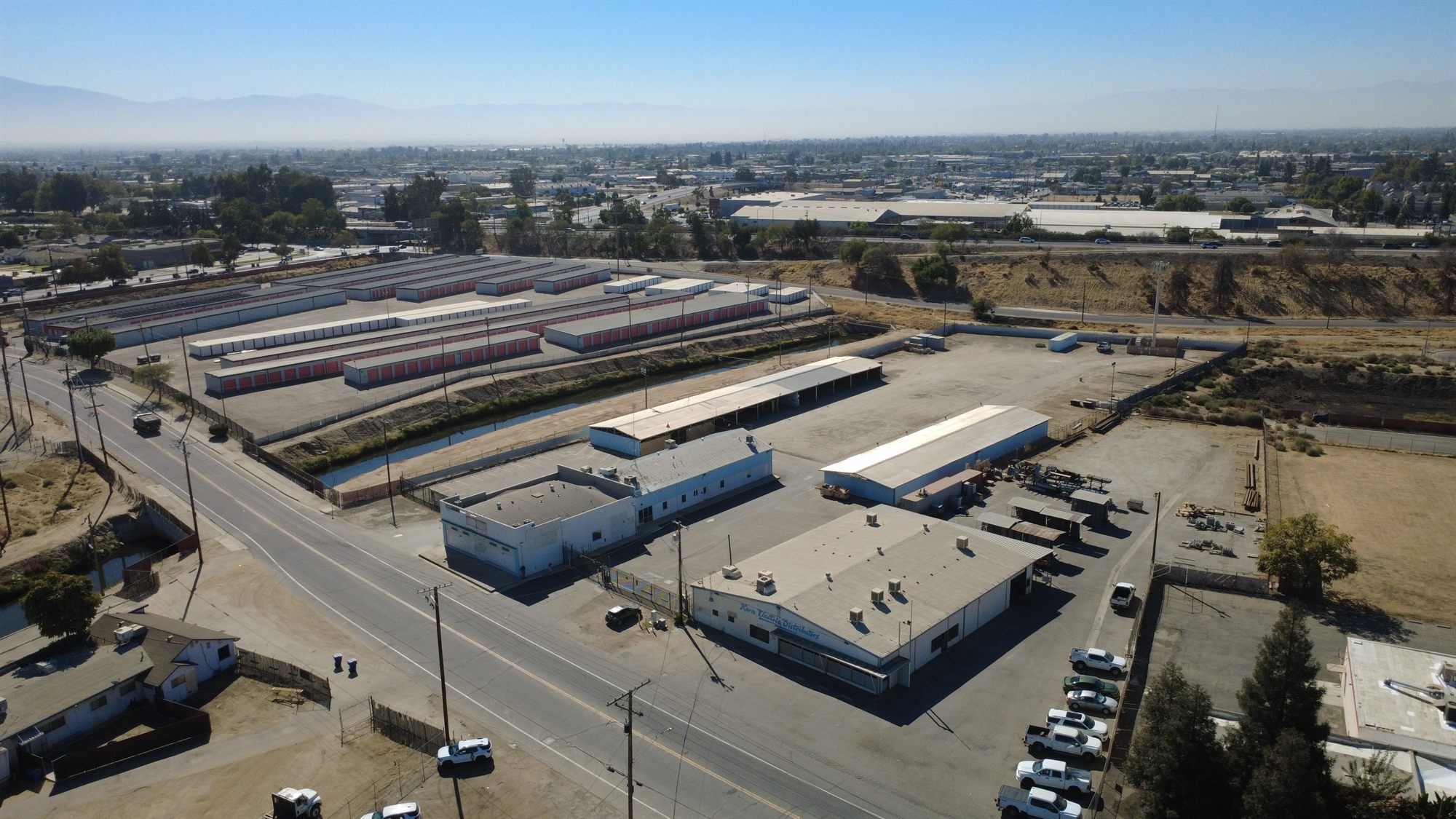
A $0.75 quote and a $9.00 quote can describe the same rent. Here is how to read a California industrial rent quote, convert it and compare buildings on what you will actually pay each month.
In California, industrial rent per square foot is usually quoted per month on a triple net (NNN) basis. A quote of “$0.75 NNN” means $0.75 per square foot each month in base rent, plus your share of property taxes, insurance and common area costs. Multiply by 12 to compare with annual quotes: $0.75 a month equals $9.00 a year.
Key takeaways
- California industrial rent is usually quoted per square foot per month. National reports and many out-of-state owners quote per square foot per year.
- To convert, multiply a monthly rate by 12 or divide an annual rate by 12. A rate of $0.71 per month equals $8.52 per year.
- A NNN quote is base rent only. Your share of property taxes, insurance and common area costs is billed on top.
- A national brokerage report put Bakersfield’s average industrial asking rent at $0.71 per square foot per month NNN in Q2 2026, with submarket averages from $0.61 to $1.56.
- Compare buildings on total monthly occupancy cost (base rent plus estimated NNN charges), not on the headline rate.
What does a quote like “$0.75 NNN” actually mean?
It means $0.75 per square foot, per month, before operating costs. When a California broker says a warehouse is “seventy-five cents NNN,” three facts sit in that phrase. The number is dollars per square foot. The period is one month. And NNN means the figure covers base rent only, before property taxes, insurance and common area maintenance.
A 40,000 SF building at $0.75 NNN carries base rent of $30,000 a month, or $360,000 a year. Your share of operating expenses comes on top, usually as a monthly estimate trued up once a year. A number without both a time period and a lease structure is not a rent quote yet. For a full comparison of lease types, see our guide to NNN, modified gross and full service leases.
Why is industrial rent quoted per month in California and per year elsewhere?
It is mostly convention, but a strong one. The AIR CRE lease forms behind most California industrial deals state Base Rent as a dollar amount per month, and local research follows suit. A national brokerage’s Q2 2026 Bakersfield industrial report reported asking rent on a monthly triple net basis. Published Inland Empire industrial figures also quote per month, NNN.
National research and many institutional owners quote per square foot per year, as most U.S. markets do. National brokerage research reports U.S. industrial asking rents annually. So does a regional brokerage’s Q2 2026 Bakersfield industrial report, which labels its rate “Avg NNN Asking Rate PSF” without naming the period. The regional brokerage report does not state a period; this article treats it as annual (about $0.84 per SF per month). Two credible sources can describe one market in units that differ by a factor of 12.
How do you convert monthly and annual industrial rent?
Multiply a monthly rate by 12 to get the annual rate, and divide an annual rate by 12 to get the monthly rate. To get dollars, multiply the rate by the square footage.
| Monthly $/SF | Annual $/SF | Monthly rent on 40,000 SF | Annual rent on 40,000 SF |
|---|---|---|---|
| $0.60 | $7.20 | $24,000 | $288,000 |
| $0.75 | $9.00 | $30,000 | $360,000 |
| $0.90 | $10.80 | $36,000 | $432,000 |
| $1.10 | $13.20 | $44,000 | $528,000 |
| $1.50 | $18.00 | $60,000 | $720,000 |
The 12x mistake
The expensive error runs in one direction. A tenant reads “$0.75” as an annual figure, budgets $30,000 a year for a building that actually costs $30,000 a month, and learns the truth at lease signing. It is an easy slip for business owners who have only leased office space, and for owners and investors used to annual quotes from other states.
What is the difference between NNN, industrial gross and modified gross quotes?
The lease structure tells you what the rate includes. Warehouse landlords most often quote NNN, but industrial gross and modified gross quotes appear too, especially on smaller multi-tenant units.
| Quote type | Property taxes | Building insurance | Common area and exterior upkeep | Utilities and interior upkeep |
|---|---|---|---|---|
| NNN (triple net) | Tenant pays its share | Tenant pays its share | Tenant pays its share | Tenant |
| Industrial gross (IG) | Landlord, often with increases over a base year passed through | Landlord, often with increases passed through | Varies by lease | Tenant |
| Modified gross (MG) | Negotiated split | Negotiated split | Negotiated split | Usually tenant |
| Full service gross | Landlord | Landlord | Landlord | Landlord (rare in industrial) |
What a quoted industrial rate usually includes.
Gross is not a standard term
Industrial gross and modified gross mean whatever the lease says they mean. A line-item list of what the landlord pays, and whether increases over a base year pass through to you, defines the real cost. A gross quote that passes through every increase after year one behaves a lot like NNN by year three. Our explainer on base year and expense stop shows how that works.
What is included in NNN charges on an industrial building?
NNN charges, also called operating expenses or CAM (common area maintenance), typically cover property taxes, the landlord’s property insurance and upkeep of common areas such as parking, landscaping, exterior lighting and paving. Multi-tenant parks usually add a property management fee. Property taxes are generally the largest single piece. Our guide to operating expense pass-throughs covers what landlords can include, and our CAM reconciliation guide shows how the year-end true-up works.
In California, the tax line deserves extra attention. Under Proposition 13, the county assessor reassesses a property to current market value when ownership changes, according to the State Board of Equalization. A building that sells during your lease can see its tax bill, and your NNN charge, jump. That is one reason two similar buildings in the same Bakersfield submarket can carry very different NNN estimates. Our Prop 13 reassessment guide explains the mechanics. Ask the landlord:
- What is the current NNN estimate, per square foot per month?
- What did last year’s reconciliation show, and was there a true-up bill?
- Are roof replacement, parking lot resurfacing or other capital work passed through, and over how many years?
- Is there a management fee, and is it a percentage of rent or of expenses?
- Has the property sold recently, or is a sale planned that could trigger reassessment?
What square footage is industrial rent based on?
Most industrial leases charge rent on the building’s or unit’s square footage as marketed. Office buildings use a rentable-plus-load-factor formula, and industrial generally does not. For multi-tenant and flex buildings with shared areas, BOMA’s industrial measurement standard (ANSI/BOMA Z65.2) is the usual reference. Our article on rentable vs. usable square feet covers the difference.
The AIR CRE single-tenant net lease says Base Rent is a fixed dollar amount that does not adjust if the actual size differs. If the flyer says 40,000 SF and a field measurement shows 38,500 SF, the monthly dollar figure in the lease still controls.
What are industrial rents in Bakersfield and Kern County right now?
Asking rents run from about $0.61 to $1.56 per square foot per month, depending on the report and submarket. The table shows how Q2 2026 sources published their figures, converted for comparison.
| Report | Market | Published as | Published figure | Converted |
|---|---|---|---|---|
| National brokerage Bakersfield industrial report | Bakersfield / Kern County | $/SF/month, NNN | $0.71 | $8.52/SF/year |
| Regional brokerage Bakersfield industrial market report | Bakersfield | $/SF, NNN (period not stated; treated as annual) | $10.05 | About $0.84/SF/month |
| National brokerage Inland Empire industrial figures | Inland Empire | $/SF/month, NNN | $1.08 | $12.96/SF/year |
| National brokerage U.S. industrial report | United States | $/SF/year, NNN | $10.32 | $0.86/SF/month |
Why the Bakersfield numbers do not match
Even after conversion, the national brokerage’s Bakersfield average ($8.52 a year) and the regional brokerage’s figure ($10.05, treated here as annual) differ. Each firm defines its inventory, submarkets and averages differently. Use one report consistently to follow the trend, and use recent lease comparables to price an actual deal. Our guide to reading an industrial market report explains the terms.
Submarkets matter more than the average
The national brokerage’s Q2 2026 data shows the spread. Outlying Kern County holds 36.7 million of the market’s 67.4 million SF of inventory and averaged $0.61 per square foot per month. North Bakersfield averaged $1.41 and Southeast Bakersfield $1.56. Smaller in-town units, often with more office finish, typically price higher per square foot than large distribution buildings in outlying areas. The report does not list which towns fall in the outlying submarket.
How do you compare two industrial rent quotes apples to apples?
Reduce every quote to one number: your expected total monthly cost for the space you can use.
- Put every quote in the same unit. We use dollars per square foot per month.
- Add the NNN estimate to every NNN quote. For gross quotes, find out which expenses the landlord pays and whether increases pass through.
- Use the same square footage basis for each building, and note whether mezzanine, office or yard area is counted.
- Line up the escalations. A 3% bump and a 4% bump look identical in year one. See annual rent escalations.
- Account for free rent and tenant improvements by calculating net effective rent.
- List what the rent does not cover: power upgrades, dock equipment repairs or sprinkler upgrades for high-piled storage.
Example: three quotes on a 40,000 SF Bakersfield warehouse
Say you are a regional distributor weighing three similar 40,000 SF buildings in Bakersfield, and the quotes arrive in three formats. The rates and NNN estimates below are illustrative assumptions, not current listings.
Building A costs $0.75 x 40,000 = $30,000 a month in base rent. NNN adds $0.15 x 40,000 = $6,000, for $36,000. Building B’s $9.60 looks higher than A’s $0.75 only because it is annual. Divided by 12 it is $0.80 a month, and its lower NNN estimate keeps the total within $800 a month of A.
Building C looks cheapest at $34,400 a month. If its gross lease passes through increases in taxes and insurance over a base year, though, a sale and Prop 13 reassessment could raise your cost later. Each building’s escalations, free rent and improvements then adjust the comparison further.
| Item | Building A | Building B | Building C |
|---|---|---|---|
| Quote as received | $0.75/SF/month NNN | $9.60/SF/year NNN | $0.86/SF/month industrial gross |
| Base rate per SF per month | $0.75 | $0.80 | $0.86 |
| Estimated NNN per SF per month | $0.15 | $0.12 | Included (landlord pays taxes, insurance, CAM) |
| All-in per SF per month | $0.90 | $0.92 | $0.86 |
| Monthly cost on 40,000 SF | $36,000 | $36,800 | $34,400 |
| Annual cost | $432,000 | $441,600 | $412,800 |
Frequently asked questions
Is industrial rent in California quoted monthly or annually?
Usually monthly. California brokers, AIR CRE lease forms and most local research state industrial rent in dollars per square foot per month, typically NNN. National reports and many out-of-state owners quote per year, so the period matters every time. A rate of $0.75 per month equals $9.00 per year, and mixing them up throws a budget off by a factor of 12.
How do I calculate monthly rent from a price per square foot?
Multiply the monthly rate by the square footage. A 25,000 SF building at $0.80 per square foot per month NNN has base rent of $20,000 a month. Then add the NNN estimate. At an assumed $0.14 per square foot, that adds $3,500, for about $23,500 a month before utilities, janitorial and your own repairs.
What does NNN mean in an industrial rent quote?
NNN, or triple net, means the quoted rate is base rent only. The tenant also pays its share of three main operating costs: property taxes, building insurance and common area maintenance. Landlords bill these monthly as an estimate and reconcile against actual costs after year end, so the NNN figure can change from year to year.
What is the average industrial rent in Bakersfield?
It depends on the source and the building. A national brokerage’s Q2 2026 report put the average asking rent at $0.71 per square foot per month NNN. A regional brokerage report showed $10.05 per square foot without naming a period, which works out to about $0.84 a month if annual. The national report’s submarket averages ran from $0.61 in Outlying Kern County to $1.56 in Southeast Bakersfield.
Do industrial landlords charge rent on the yard or truck court?
Rent is normally charged on building square footage, and the truck court and parking come with the building. Excess or secured yard is sometimes priced separately, especially for outdoor storage users. Yard area does not appear in the building’s square footage, so write its size, fencing, paving and exclusivity into the letter of intent and the lease.
What is a typical NNN charge on an industrial building?
It varies enough that the current estimate and last year’s reconciliation are better guides than an average. Property taxes are usually the biggest piece, and in California they can reset when the property sells. Multi-tenant parks with more common area, and buildings that sold recently, often carry higher NNN charges than long-held buildings.
If you are weighing industrial buildings in Bakersfield or elsewhere in Kern County, Kern CRE can put every option on the same all-in monthly basis so the decision comes down to the building, not the math. Call Kern CRE at 855-KERN-CRE (855-537-6273) or contact us. Get Kern County CRE news monthly: subscribe to the Kern CRE report.
Sources
- Regional brokerage market reports (Bakersfield industrial, Q2 2026).
- Regional brokerage market reports (Bakersfield industrial, July 2026).
- Regional brokerage market reports (Inland Empire industrial, Q2 2026).
- National brokerage market reports (U.S. industrial, Q2 2026).
- Standard Industrial/Commercial Single-Tenant Lease, Net (form STN-27.10, revised 11-01-2017), AIR CRE, November 2017.
- Standard Industrial/Commercial Multi-Tenant Lease, Net (form MTN-26.10, revised 11-01-2017), AIR CRE, November 2017.
- Industrial (ANSI/BOMA Z65.2) floor measurement standard, BOMA International, undated.
- Change in Ownership: Frequently Asked Questions, California State Board of Equalization, undated.
About this article
Kern CRE prepared this article with help from AI research and writing tools. An editor reviewed the draft, checked its facts against the sources linked above and edited it for accuracy and clarity. It is general information, not legal, tax, investment or financial advice; talk with a qualified professional about your situation.