
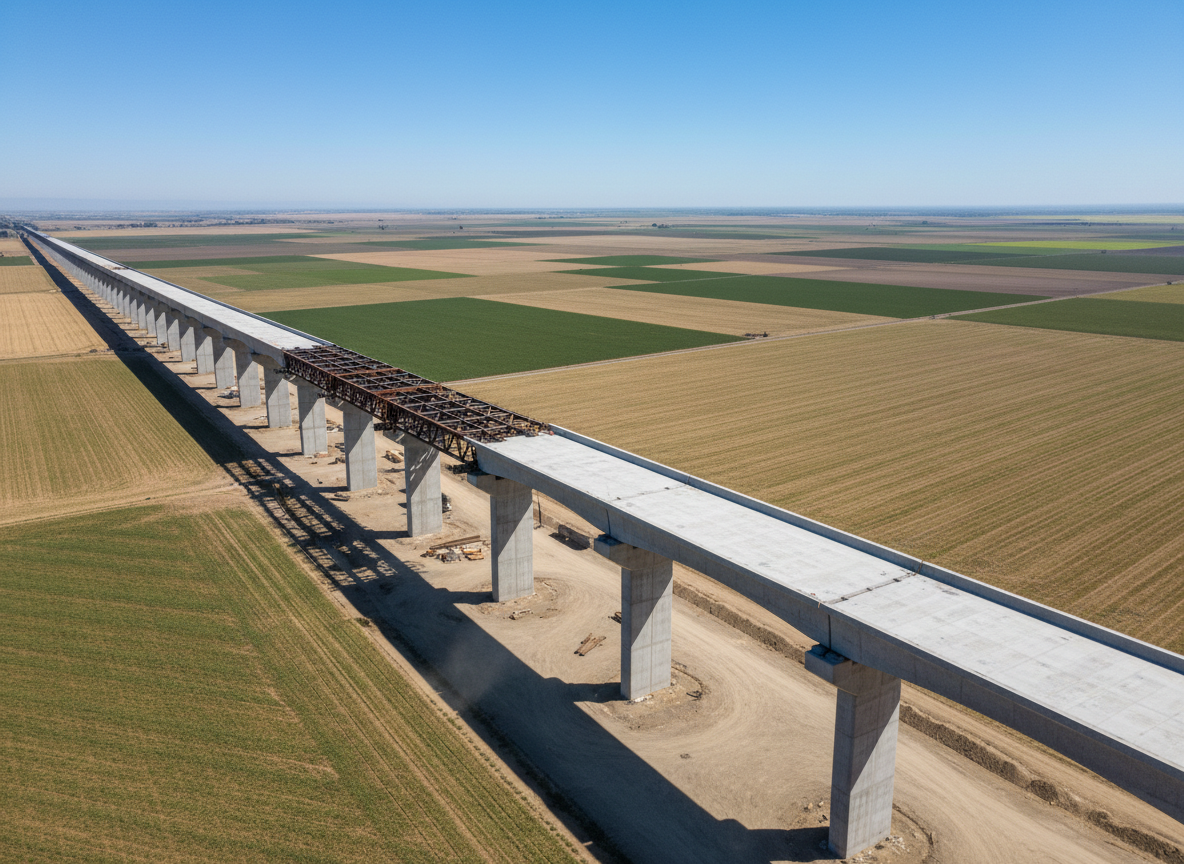
The bullet train’s Bakersfield stop is no longer planned for downtown, at least at first. Here is what the 2026 Business Plan changed, how the line is paid for after the loss of federal grants and how property owners should read it.
The high speed rail Bakersfield station is moving. The California High-Speed Rail Authority’s 2026 plan shifts the first stop about 6 miles north of downtown, to an interim site north of 7th Standard Road near Meadows Field. The Merced to Bakersfield segment now costs $35.7 billion and targets 2032 to 2033, funded largely by state cap-and-invest money after federal grants were cut.
High-speed rail in Bakersfield at a glance
| Item | Detail |
|---|---|
| Project | California High-Speed Rail, Merced to Bakersfield early operating segment |
| Agency | California High-Speed Rail Authority (CHSRA) |
| Bakersfield station | Interim station north of 7th Standard Road with access to Meadows Field (per the Authority’s cost report, as quoted by Bakersfield Now); downtown station deferred |
| Cost | $35.7 billion for Merced to Bakersfield (final 2026 Business Plan) |
| Schedule | Completion of the early operating segment targeted for 2032 to 2033 |
| State funding | SB 840 (2025) directs $1 billion a year of cap-and-invest revenue to high-speed rail |
| Federal funding | More than $4 billion in federal grants terminated in 2025; the Authority sued July 17, 2025, filed a voluntary dismissal Dec. 23, 2025, and the case was dismissed Jan. 7, 2026 |
| Status | Under construction in the Central Valley; right-of-way acquisition continuing near Bakersfield |
| What to watch | Legislative response to scope changes, station-area environmental review, maintenance facility contract, financing plan |
Key takeaways
- The Authority’s draft 2026 Business Plan moved the Bakersfield terminus to the outskirts of the city, about 6 miles north of the previously planned station, according to the Legislative Analyst’s Office (LAO) review of April 27, 2026.
- The final 2026 Business Plan, dated June 2026, puts the Merced to Bakersfield segment at $35.7 billion and targets completion in 2032 to 2033.
- SB 840 (Chapter 121, Statutes of 2025) directs $1 billion a year of cap-and-invest revenue to high-speed rail, which the LAO counts as about $15 billion through 2045.
- The Authority sued July 17, 2025 over the termination of more than $4 billion in federal grants, then voluntarily dismissed the case, which the court closed without prejudice Jan. 7, 2026.
- The Authority calls the new Bakersfield stop an interim location that will not block a future alignment to downtown Bakersfield and Palmdale.
Where is the high speed rail Bakersfield station going?
The first Bakersfield station is now planned north of 7th Standard Road, near Meadows Field Airport, about 6 miles from the earlier downtown site. For most of the past decade, the plan was a downtown station. In 2018, the Authority announced that the City of Bakersfield approved a vision plan for downtown and the station, covering an area generally bounded by F Street, 38th Street, Union Avenue and California Avenue. The plan set goals for transportation, housing, jobs, retail and walkability around a downtown stop.
The 2026 plan changed that, at least for the first phase. The LAO’s April 27, 2026 review of the draft plan reports that the Bakersfield terminus shifted to the outskirts of the city, about 6 miles north of the previously planned station. The Merced end also moved about 3.5 miles south of downtown Merced. The first segment is now described as South Merced to North Bakersfield, 162 miles instead of 171.
On June 25, 2026, Bakersfield Now reported that the Authority had dropped its downtown station and shifted the stop north of 7th Standard Road. The Authority’s Capital Cost Basis report, quoted in that story, calls it an interim location with strategic access to Meadows Field Airport that will not block the future track alignment continuing to downtown Bakersfield and Palmdale. According to the outlet, the Authority did not explain why it made the change.
Bakersfield station: before and after the 2026 Business Plan
| Item | Earlier plan | 2026 Business Plan |
|---|---|---|
| Station location | Downtown Bakersfield | Interim station north of 7th Standard Road, near Meadows Field |
| First segment | Merced to Bakersfield, 171 miles | South Merced to North Bakersfield, 162 miles |
| Track | Double track assumed | 144 of 162 miles single-tracked (draft plan) |
| Downtown service | From opening | Deferred; alignment preserved for a future extension |
Sources: LAO review of the Draft 2026 Business Plan; Bakersfield Now, June 25, 2026.
Why did the Authority move the Bakersfield station?
The Authority has not given a full public explanation, but the plan documents point to cost and schedule. The LAO notes that the draft plan shortens the first segment at both ends and assumes single track on 144 of its 162 miles. Both choices reduce what must be built in the first phase. A northern stop near Highway 99 also appears to avoid building through central Bakersfield at the start, though the Authority has not said so.
Local reaction has focused on cost and site conditions downtown. Michael Turnipseed, board chairman of the Kern County Taxpayers Association, told Bakersfield Now that the downtown site sits on river sand and a flood plain and would cost too much. For downtown owners, the key point is the Authority’s statement that the downtown alignment is preserved for a later phase.
What does the 2026 Business Plan say about cost and schedule?
The final 2026 Business Plan puts the Merced to Bakersfield segment at $35.7 billion and targets completion of the early operating segment in 2032 to 2033. It says stations, including Bakersfield, will be designed to meet operational needs for initial service, with full buildout as the system grows. It also lists a maintenance facility contractor bid on its 2026 schedule.
The LAO was critical of the draft. It found the plan did not include the elements required by AB 377, put key scope changes in a separate technical document and assumed, rather than proposed, changes to the scope the Legislature set in SB 198. It estimated $39 billion in available funding and a roughly $1 billion gap for the shortened segment once borrowing costs are counted. It put the full Phase I system at $126 billion. It asked the Legislature to decide which scope to fund, from Madera to Shafter up to Gilroy to Bakersfield. Most of the legislation the Authority sought this year did not pass, according to news reports in late September 2026.
How is California high-speed rail funded after the federal cuts?
State climate money is now the backbone. SB 840 (Chapter 121, Statutes of 2025), signed with the cap-and-invest extension, directs $1 billion a year from the Greenhouse Gas Reduction Fund to high-speed rail as part of a tiered spending plan. The LAO counts this as about $15 billion and describes it as $1 billion annually from 2030 through 2045. Those two LAO figures do not divide evenly across the years, so treat $15 billion as the LAO’s approximate total. The LAO also notes that auction revenue can fall in downturns. Our explainer on California cap-and-invest covers the program.
Federal money went the other way. Gov. Gavin Newsom announced July 17, 2025 that California was suing over the federal termination of high-speed rail grants. The Authority’s case in the U.S. District Court for the Eastern District of California (No. 2:25-cv-02004, before Judge Dale Alan Drozd) challenged the loss of more than $4 billion under the Administrative Procedure Act. The Authority filed a notice of voluntary dismissal on Dec. 23, 2025, citing the federal government’s unreliability as a funding partner and plans to pursue private lenders. The court dismissed the case without prejudice Jan. 7, 2026, according to the Civil Rights Litigation Clearinghouse docket summary. Trains also reported the move.
The LAO’s figures reflect a $4 billion loss in federal funds compared with earlier plans. Voter-approved bonds from Proposition 1A (2008) remain part of the funding picture. The draft plan also floated a public-private partnership as an alternative to conventional borrowing, with few details.
Main funding sources for the Merced to Bakersfield segment (as described in 2026)
| Source | Status in 2026 | Notes |
|---|---|---|
| Cap-and-invest (SB 840) | Enacted 2025 | $1 billion a year; LAO counts about $15 billion through 2045 |
| Proposition 1A bonds | Authorized 2008 | Original $9 billion authorization |
| Federal grants | More than $4 billion terminated in 2025 | Lawsuit voluntarily dismissed; closed Jan. 7, 2026 |
| Borrowing or public-private partnership | Proposed | Needs legislative approval and investor interest |
What is happening on the ground near Bakersfield?
Right-of-way work continues. At its Feb. 6, 2026 meeting, the State Public Works Board considered a resolution of necessity authorizing the Authority to use eminent domain for Merced to Bakersfield parcels, including a leasehold interest near Olive Drive in Bakersfield. A resolution of necessity is the step that lets the state file a condemnation case if it cannot reach agreement with an owner.
Because the interim station moved north, owners near 7th Standard Road and Highway 99 should expect more survey, appraisal and acquisition activity than before. Some downtown parcels tied to a station footprint may see plans change.
What could the station move mean for nearby property?
Be careful with station premiums. A station lifts nearby values only if trains run often enough to change how people travel, and passenger service here is targeted for 2032 to 2033 at the earliest. Until then, a parcel’s value near the interim station depends mainly on today’s drivers: Highway 99 and Highway 65 access, Meadows Field, zoning and utilities. This is general reasoning, not a finding from property-value research on rail stations.
Near 7th Standard Road, the station adds a long-term anchor to an area already seeing industrial interest, including the 1.5 million square foot Airport Commerce Center proposal headed to the Kern County Board of Supervisors on Oct. 13. Construction staging, parking and supporting uses could add demand for industrial outdoor storage and flex space during the build-out.
Downtown, the change removes a near-term catalyst, but the Authority says the downtown alignment is preserved for a later phase. The City of Bakersfield’s 2045 General Plan update and any revised station-area planning, not a station date, now set the downtown outlook. AB 2011 rules for commercial-to-residential projects may apply to conversions on downtown commercial land.
Checklist for owners and buyers near the alignment
- Map the parcel against the Authority’s current alignment and the new interim station area.
- Look for recorded notices, survey entry agreements or prior offers from the Authority.
- Relocation benefits may apply to businesses that receive an offer.
- For acquisitions near 7th Standard Road, model value without the station first, then treat the station as upside.
- For downtown parcels, the city’s general plan and zoning matter more than the 2018 station vision.
- Legislative action on the 2026 Business Plan could change scope, timing and funding.
What should Kern County watch next on high-speed rail?
Four items will shape the next year. First, whether the Legislature accepts the shortened South Merced to North Bakersfield scope and single tracking. Second, environmental review and design for the interim station north of 7th Standard Road. Third, the maintenance facility contract and any public-private financing. Fourth, cap-and-invest auction revenue, which funds the bulk of the work.
Frequently asked questions
Where will the high-speed rail station be in Bakersfield?
Under the 2026 plan, the first Bakersfield station is an interim stop north of 7th Standard Road, with access to Meadows Field Airport. That is about 6 miles north of the earlier downtown site. The Authority says the location will not block a future alignment to downtown Bakersfield and Palmdale. Exact boundaries and design are still in development.
Is the downtown Bakersfield high-speed rail station canceled?
It is deferred, not formally abandoned. Bakersfield Now reported June 25, 2026 that the Authority dropped the downtown station for the first phase. The Authority’s cost report says the interim site will not block the track extending to downtown and Palmdale, so downtown service depends on later phases and funding.
When will high-speed rail trains run to Bakersfield?
The final 2026 Business Plan targets 2032 to 2033 for completing the Merced to Bakersfield early operating segment. The LAO noted that the schedule assumes statutory changes and enough funding, including about $1 billion a year in cap-and-invest revenue. If either falls short, the date could slip.
How much does the Merced to Bakersfield segment cost?
The final plan puts it at $35.7 billion. The LAO’s review of the draft cited $36 billion for the shortened South Merced to North Bakersfield version and a funding gap of roughly $1 billion once borrowing costs are included. The LAO put the full San Francisco to Los Angeles and Anaheim system at $126 billion.
What happened to federal funding for California high-speed rail?
The federal government terminated more than $4 billion in grants in 2025. California’s Authority sued July 17, 2025, filed a voluntary dismissal Dec. 23, 2025, and saw the case closed without prejudice Jan. 7, 2026. The project now leans mainly on state money, especially $1 billion a year in cap-and-invest revenue under SB 840.
Can the High-Speed Rail Authority take my property?
Yes, for the project, through eminent domain after the State Public Works Board adopts a resolution of necessity. The board considered one for Merced to Bakersfield parcels Feb. 6, 2026. Owners are entitled to just compensation, and businesses may qualify for relocation help. Get an independent appraisal and an eminent domain attorney before accepting an offer.
If you own or are considering property near the 7th Standard Road corridor or downtown Bakersfield, call Kern CRE at 855-KERN-CRE (855-537-6273) or contact us to sort out what the station change does and does not mean for value today. Get Kern County CRE news monthly: subscribe to the Kern CRE report.
Sources
- High-Speed Rail Draft 2026 Business Plan (handout), Legislative Analyst’s Office, April 27, 2026.
- 2026 Business Plan (Final), California High-Speed Rail Authority, June 2026.
- California high-speed rail drops downtown Bakersfield station, shifts north of 7th Standard Road, Bakersfield Now (KBAK), June 25, 2026.
- Staff Analysis, Resolution of Necessity, Merced to Bakersfield, State Public Works Board, Feb. 6, 2026.
- California SB 840 (2025): Chapter 121, Statutes of 2025, LegiScan.
- California sues to stop Trump’s politically motivated attack on high-speed rail, Office of Governor Gavin Newsom, July 17, 2025.
- California High-Speed Rail Authority v. United States Department of Transportation, No. 2:25-cv-02004 (E.D. Cal.), Civil Rights Litigation Clearinghouse.
- California drops suit over cancellation of high-speed rail funding, Trains, Dec. 26, 2025.
- City of Bakersfield Approves Vision Plan for Downtown Bakersfield and High-Speed Rail Station, California High-Speed Rail Authority, May 10, 2018.
About this article
Kern CRE prepared this article with help from AI research and writing tools. An editor reviewed the draft, checked its facts against the sources linked above and edited it for accuracy and clarity. It is general information about California high-speed rail plans, which are subject to legislative and agency changes. It is not legal, appraisal or financial advice; owners contacted about acquisition should consult an eminent domain attorney.