
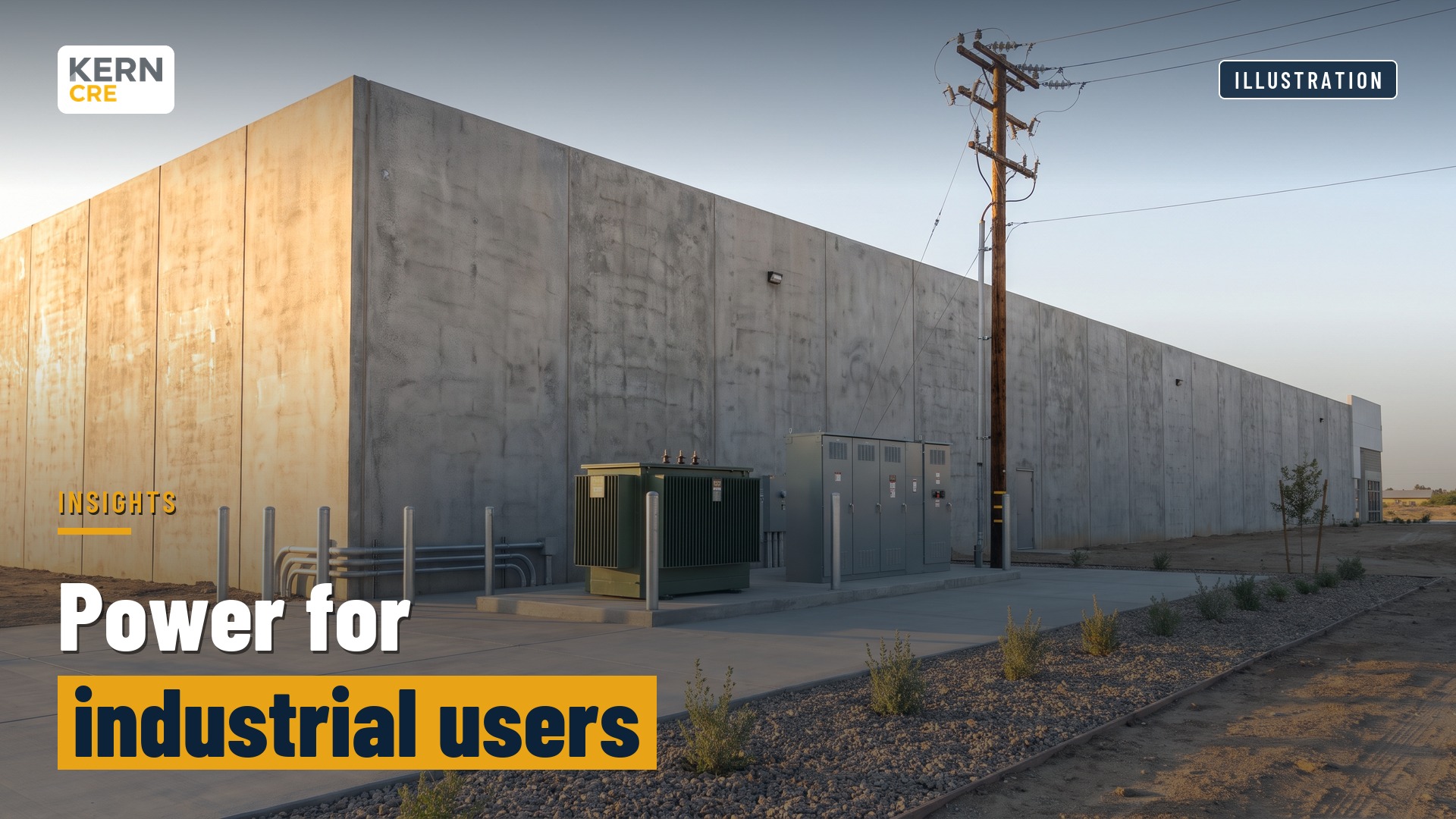
How to read a building’s electrical service, how much power different industrial users need, and how to keep a utility upgrade from delaying your move in Kern County.
Industrial building power requirements depend on the use. A basic storage warehouse may run on a few hundred amps. Manufacturing, cold storage and automated facilities typically need three-phase service of 2,000 amps or more, usually at 277/480 volts. Utility upgrades can take many months, so capacity matters before a lease is signed or purchase contingencies are removed.
Key takeaways
- Electrical service is described by amps, voltage and phase. Multiply them out to kVA to compare buildings like for like.
- Power needs have risen with automation, refrigeration and EV charging. Power is now a primary site-selection filter alongside clear height and docks.
- In Kern County, Pacific Gas and Electric (PG&E) serves Bakersfield and most of the county, while Southern California Edison (SCE) serves parts of eastern Kern. The serving utility depends on the parcel.
- Utility upgrades can take many months. California now requires the California Public Utilities Commission (CPUC) to set energization timelines and track delays.
- Put power in the letter of intent: the amps and voltage to be delivered, who pays for upgrades and what happens if the utility is late.
How is industrial power measured?
A building’s electrical service is described by three numbers: amps (current capacity), volts and phase. Industrial buildings almost always use three-phase power, which runs motors, compressors and large equipment efficiently. Link Logistics notes that industrial facilities typically operate three-phase systems between 208 and 480 volts, and that the main switchboard is the most reliable indicator of a building’s true capacity.
Amps alone can mislead. A 1,200-amp service at 208 volts delivers far less power than a 1,200-amp service at 480 volts. To compare buildings, convert to kilovolt-amperes (kVA). For three-phase service, kVA = volts x amps x 1.732 / 1,000.
Common three-phase services converted to kVA
| Service | Approximate capacity | Typical fit |
|---|---|---|
| 400 amps at 120/208V | 144 kVA | Small warehouse, contractor shop, flex suite |
| 800 amps at 277/480V | 665 kVA | Distribution with HVAC, light manufacturing |
| 1,200 amps at 277/480V | 998 kVA | Manufacturing in a mid-size building |
| 2,000 amps at 277/480V | 1,663 kVA | Cold storage, food processing, heavy automation |
| 4,000 amps at 277/480V | 3,325 kVA | Large manufacturing or power-intensive users |
What are industrial building power requirements by use?
Requirements have climbed. Link Logistics reports that standard distribution buildings historically ran on about 400 amps, modern facilities with full HVAC often need 600 to 800 amps, and manufacturing tenants can need 1,200 amps or more for a single 50,000 SF space. It also notes that manufacturing, cold storage and automated warehouses typically require 2,000 amps or more of three-phase service.
The drivers are familiar: conveyors and robotics, refrigeration, air-conditioned warehouses, and electric forklifts, trucks and vans. A fleet depot charging dozens of vehicles at once can need as much power as a factory. A Q2 2026 report from a national brokerage noted that tenants prioritized power availability, automation-ready specifications and labor access over discounted rents. Link Logistics now describes power as a primary filter alongside clear height and loading docks. For the other specs that matter, see our guide to industrial building specifications.
- Storage warehouse or contractor shop: lighting, dock equipment and a small office; often a few hundred amps.
- Distribution with HVAC or light automation: several hundred to about 800 amps at 480V.
- Manufacturing and food processing: often 1,200 to 2,000-plus amps at 480V, depending on equipment.
- Cold storage: high, continuous refrigeration load; 2,000 amps or more is common. See cold storage and ag-industrial facilities in Kern County.
- EV fleet charging: depends on chargers and fleet size; can exceed everything else on site.
Which utility serves industrial property in Kern County?
PG&E serves Bakersfield and most of Kern County, including the valley floor communities of Shafter, Wasco, Delano, McFarland and Arvin. SCE serves parts of eastern Kern, including areas around Tehachapi and Mojave. Service boundaries do not always follow city limits, so the serving utility varies by parcel, especially near Tejon, Tehachapi and the desert communities.
The utility matters because each has its own application portal, engineering queue, tariffs and cost rules. For PG&E, new service and upgrades start in the Your Projects portal, and PG&E says on its Building and Renovation Services page that a representative is assigned within five business days of a new application.
What does a utility service upgrade involve, and how long does it take?
An upgrade usually runs through the same broad steps whichever utility serves the site:
- Your electrical engineer prepares a load calculation and single-line diagram.
- You apply to the utility, which reviews whether the local line and transformer can carry the new load.
- The utility designs the job and issues cost estimates and contracts. You pay required costs.
- Your contractor installs on-site work and pulls permits while the utility installs its facilities.
- The city or county inspects, and the utility energizes the new service.
Who installs and pays for what?
Under PG&E’s Electric Rule 16, PG&E installs and owns service conductors, service transformers and its meters. The applicant handles on-site trenching and backfill, conduits and substructures, transformer pads or vaults, and service equipment past the delivery point. The applicant pays costs in excess of any allowance. This is a simplified summary, and allowances and cost rules change through CPUC proceedings. SCE has its own tariff rules.
How long should you plan for?
There is no single answer. Link Logistics cites a non-California market (Greensboro) where sourcing additional power from the grid can take 10 to 12 months in some cases. That is an example from outside California, not a Kern County benchmark. Jobs that need line extensions or substation work can take longer.
Delays became serious enough statewide that California passed SB 410 and AB 50 in 2023. In September 2024 the CPUC adopted Decision 24-09-020, which sets energization timelines and a procedure for customers to report delays. See the CPUC energization page and our explainer on SB 410 energization timelines. Plan the power schedule alongside permits and build-out, not after them.
Is power a constraint for industrial users around Bakersfield?
It depends on the site. Published PG&E, CPUC and brokerage reports do not describe a Bakersfield-wide shortage of power for industrial users as of 2026. A July 2026 Hickey Institute report on grid reliability and commercial real estate pointed to Texas, the Southwest and major data center corridors as the tightest markets. Capacity still varies by site.
That does not mean every Kern County building can get more power quickly. Capacity is set feeder by feeder and substation by substation, and statewide energization delays were real enough to prompt new law. A user adding refrigeration, production lines or fleet charging can trigger upgrades beyond the building, and those take time. Treat power as a due diligence item, never an assumption. Our due diligence checklist for industrial buyers covers the rest.
How do you verify a building’s power before you lease or buy?
Verify before the letter of intent is signed, not during build-out:
- Read the main switchgear nameplate for amps and voltage, and photograph it.
- Find the utility transformer and note its kVA rating if tagged.
- Review 12 months of utility bills for peak demand to see how much of the service is actually in use.
- Have an electrician check panel condition, spare capacity and any code issues.
- Ask the utility early whether the local system can support your added load, and get upgrade estimates in writing.
- Plan for growth: automation, refrigeration or EV charging you expect in the next five years.
How should power be handled in the LOI and lease?
Write the electrical requirement into the letter of intent: the amps, voltage and phase the landlord will deliver, who pays for any upgrade and the target date. In a lease, tie rent commencement to energization if the upgrade is on the landlord. Consider a termination or rent credit right if the utility misses a deadline. Upgrade costs can also run through the tenant improvement allowance, so settle that in the same negotiation.
Buyers should keep a contingency open, or negotiate an extension, until the utility confirms service can be provided at a known cost. Owners with strong power should market it, because it is now one of the first questions sophisticated tenants ask. For the full sequence, see how to lease industrial space.
Worked example: what does a power delay cost a cold storage user near Delano?
A 12-month utility timeline against a 4-month build-out leaves an 8-month gap, and the gap can cost six figures. This example is illustrative. An ag cold storage operator wants to lease a 60,000 SF building near Delano. Its engineer estimates a load of 1,500 kVA. The building has an 800-amp, 277/480-volt service, about 665 kVA.
At 480 volts, 1,500 kVA requires about 1,804 amps (1,500,000 / (480 x 1.732)), so the user needs a 2,000-amp service. The utility must add roughly 835 kVA of capacity beyond what the building has today.
Assume the build-out takes 4 months but the utility upgrade takes 12. If the operator must keep paying $40,000 per month at its current facility while it waits, the delay costs $320,000 before counting lost business. Both the timeline and the rent figure are assumptions. That is why the power requirement, responsibility for the upgrade and a rent commencement tied to energization belong in the LOI.
Power gap and delay cost (illustrative)
| Item | Figure |
|---|---|
| Existing service | 800 A at 480V, about 665 kVA |
| Required load | 1,500 kVA, about 1,804 A at 480V |
| Service needed | 2,000 A at 480V, about 1,663 kVA |
| Build-out vs. utility timeline (assumed) | 4 months vs. 12 months |
| Cost of 8-month gap at $40,000 per month (assumed) | $320,000 |
Frequently asked questions
How many amps does a warehouse need?
It depends on what the building does. A basic storage warehouse may need only a few hundred amps. Link Logistics says distribution buildings historically ran on about 400 amps and modern ones with full HVAC often need 600 to 800. Manufacturers can need 1,200 amps or more in a 50,000 SF space, and cold storage or heavily automated buildings typically need 2,000 or more.
What voltage do industrial buildings use?
Most use three-phase power. Larger buildings typically have 277/480-volt service, which suits motors, compressors and lighting, while smaller buildings and flex suites often have 120/208-volt service. Voltage matters as much as amps, because the same amperage at 480 volts delivers far more power than at 208. Compare buildings in kVA.
How do I convert amps to kVA for three-phase power?
Multiply volts by amps by 1.732, then divide by 1,000. An 800-amp service at 480 volts works out to about 665 kVA, and a 2,000-amp service at 480 volts to about 1,663 kVA. With kVA you can line buildings with different voltages up against your engineer’s load estimate.
How long does a PG&E service upgrade take?
It varies with the size of the load and whether the line, transformer or substation must be upgraded. Some jobs move fairly quickly. Those needing new lines, transformers or substation work can take many months. PG&E says it assigns a representative within five business days of an application, and the CPUC adopted energization timelines in 2024. Start as early as you can.
Who pays for an electrical upgrade in a leased industrial building?
It is negotiable. Under PG&E’s Rule 16 the applicant generally pays for on-site trenching, conduit and transformer pads, plus utility costs beyond any allowance, while the utility installs and owns the transformer and service conductors. Between landlord and tenant, the LOI should name who pays, the amps and voltage to be delivered and the remedy if energization runs late.
Is power a problem for industrial buildings in Bakersfield?
Not as a general rule as of 2026. The PG&E, CPUC and brokerage reports cited here do not name Bakersfield as a capacity-constrained industrial market. Capacity is still site-specific, though. Adding refrigeration, production equipment or EV charging can trigger utility upgrades that take months, so power varies building by building.
Which utility serves my property in Kern County?
PG&E serves Bakersfield and most of the county, including Shafter, Wasco, Delano, McFarland and Arvin. SCE serves parts of eastern Kern, including areas around Tehachapi and Mojave. Boundaries do not always follow city limits, so the serving utility depends on the parcel.
If power is a must-have for your operation, we can help you screen Kern County buildings for electrical service up front and build the utility timeline into your LOI. Call Kern CRE at 855-KERN-CRE (855-537-6273) or contact us. Get Kern County CRE news monthly: subscribe to the Kern CRE report.
Sources
- Power Capacity in Warehouse Site Selection, Link Logistics, August 2026.
- Warehouse Power Capacity: How Much Power Does Your Warehouse Need?, Link Logistics, April 2026.
- How to Choose Industrial Warehouse Space: Essential Features to Consider, Link Logistics, December 2025 (updated March 2026).
- National brokerage market reports (U.S. industrial, July 2026).
- Electric Grid Reliability and Commercial Real Estate, CREDA (formerly NAIOP), Hickey Institute, July 2026.
- Energization (SB 410, AB 50; Decisions D.24-07-008 and D.24-09-020), California Public Utilities Commission.
- Electric Rule No. 16, Service Extensions, PG&E, revised May 17, 2025 (Advice 7572-E).
- Building and Renovation Services, PG&E.
About this article
Kern CRE prepared this article with help from AI research and writing tools. An editor reviewed the draft, checked its facts against the sources linked above and edited it for accuracy and clarity. It is general information, not legal, tax, investment or financial advice; talk with a qualified professional about your situation.