
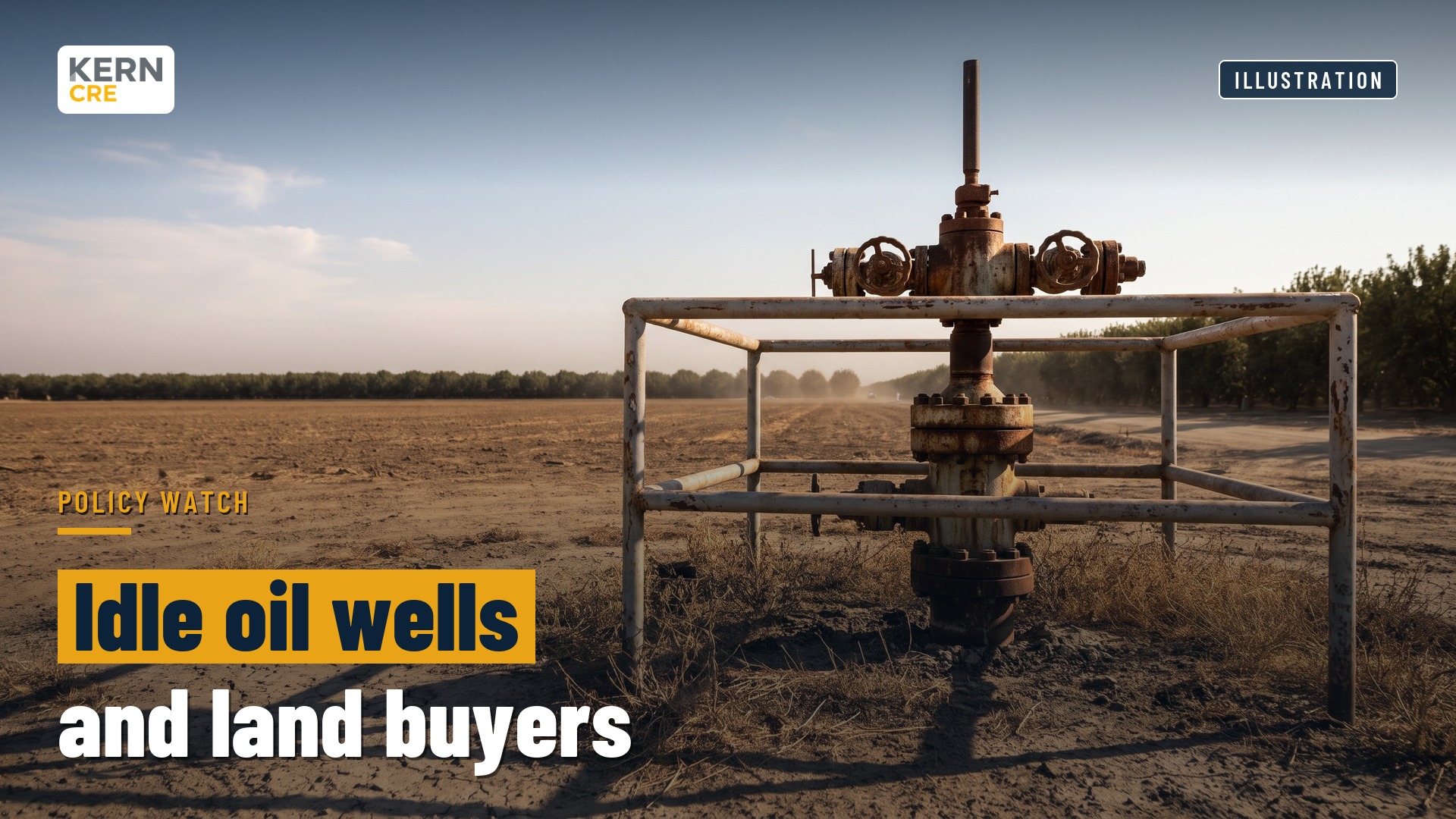
California has tightened the rules on idle and orphan wells since 2016. Here is who pays to plug a well, what changed in 2023 and 2024, and how to check a Kern parcel before you buy or build.
Idle oil wells in Kern County are wells that have gone 24 consecutive months without producing or serving for injection and have not been permanently plugged. State law makes the operator responsible for plugging them, and California has tightened bonding and plugging rules since 2016. Landowners and developers can still face costs when construction disturbs an old well.
Idle wells and land purchases at a glance
| Item | Detail |
|---|---|
| Key laws | AB 2729 (Williams), Chapter 272, Statutes of 2016; AB 1167 (Carrillo), Chapter 359, Statutes of 2023; AB 1866 (Hart), Chapter 548, Statutes of 2024 |
| Administered by | CalGEM (the Geologic Energy Management Division of the California Department of Conservation); local building departments for construction near wells |
| Statewide scale | About 32,000 idle wells, per CalGEM; more than 5,300 orphan or likely orphan wells, per CalGEM’s October 2024 plan |
| Who must plug | The operator of record; CalGEM can plug deserted wells and recover costs from responsible operators |
| New on transfers | Since AB 1167, a well acquisition is not complete until the buyer posts security covering the full cost of plugging, decommissioning and site restoration |
| Plugging pace | AB 1866 raised the share of idle wells operators on management plans must eliminate each year, to as much as 20% for the largest operators by 2030 |
| Public money | $25 million federal initial grant (2022), up to $165.8 million in federal formula funds and $100 million in state funds for orphan wells |
| Status | All three laws in effect; CalGEM plugging orphan wells in phases, with Kern sites frequent on its Phase 2 list |
Key takeaways
- CalGEM’s idle well page counts about 32,000 idle wells statewide, while CalMatters reported about 40,000 in September 2024. CalGEM’s October 2024 plan estimated more than 5,300 orphan or likely orphan wells.
- AB 1167 bars recognizing a well acquisition as complete until the buyer files security covering the full cost of plugging, decommissioning and site restoration.
- AB 1866, chaptered Sept. 25, 2024, raised the minimum share of idle wells that operators on management plans must eliminate each year.
- CalGEM’s first phase of orphan well work budgeted about $80 million for 378 wells, roughly $212,000 per well, which shows why plugging liability matters in a land deal.
- For a buyer of Kern land with wells, each well’s status and operator in CalGEM records matter before closing, because development that disturbs a well can shift costs to the owner.
What is an idle oil well, and how many are there?
An idle well is one that has not produced oil or gas, or been used for injection, for 24 consecutive months, according to CalGEM. A well idle for eight years or more is a long-term idle well. Wells move through a life cycle: active, idle, plugged and abandoned, and, when no responsible operator can be found, orphan.
Idle wells are the risk point because steel casing and cement degrade over time, and an unplugged well can leak oil, gas or brine. CalGEM’s page counts about 32,000 idle wells. CalMatters reported in September 2024 that California has about 40,000 that will need plugging, so the count depends on the date and definition. CalGEM’s October 2024 expenditure plan estimated more than 5,300 orphan or likely orphan wells statewide and said Kern sites appear frequently on its Phase 2 plugging list.
ESG Dive, citing 2018 figures, reported that Kern County had 80% of the state’s active oil and gas wells.
What do California’s idle well laws require?
Four laws now shape idle well liability. They apply to operators, but they change what a buyer of land or a well is stepping into.
| Law | What it does | Why it matters in a land deal |
|---|---|---|
| AB 2729 (Chapter 272, Statutes of 2016) | Rewrote idle well rules in Public Resources Code 3206 and related sections: annual idle well fees or an idle well management plan, plus testing | Shows whether an operator has been paying or plugging; long-idle wells are the ones most likely to need work |
| AB 1167 (Chapter 359, Statutes of 2023) | Requires a buyer of wells or production facilities to file security covering the full cost of plugging, decommissioning and site restoration | Cuts the risk of wells being sold to thinly capitalized operators who later walk away |
| AB 1866 (Chapter 548, Statutes of 2024) | Raises idle well fees, adds fees for wells idle under three years and speeds up plugging under management plans | More plugging activity on and near Kern parcels through the late 2020s |
| SB 1137 (Chapter 365, Statutes of 2022) | Bars new well and rework permits within 3,200 feet of homes, schools and other sensitive receptors, but allows plugging | Idle wells near homes or public-facing businesses generally can only be plugged, not revived; see our SB 1137 guide |
How does AB 1167 work when wells change hands?
AB 1167 makes a well buyer post full-cost security before the deal counts as complete. The State Oil and Gas Supervisor sets the amount at the estimated cost of plugging, decommissioning and site restoration, and the acquisition is not recognized until the security is filed. Acceptable forms include a bond, an irrevocable letter of credit or a fully funded trust. Self-insurance and corporate guarantees do not count.
The bill exempts a well whose average daily production exceeds 15 barrels of oil or 60,000 cubic feet of natural gas during the 12 months before the acquisition, according to the bill text.
What does AB 1866 change about plugging?
AB 1866 speeds up plugging by raising the minimum share of idle wells an operator must eliminate each year. The chaptered bill applies the requirement to all idle wells, not just long-term ones, and raises the minimum percentages. KEYT reported that the largest operators face a 15% annual requirement at the start and 20% a year by 2030. The law also raises idle well fees and adds a fee for wells idle less than three years. It tells operators to weigh well age and threats to life, health, property or resources, and it prioritizes wells within 3,200 feet of a sensitive receptor.
The exact percentage for each operator size and year, and the fee amounts, are set in Public Resources Code Section 3206.
Who pays to plug an oil well on land you buy?
The operator of record pays, not the surface owner. The operator holds the permit, posts the bond and must plug the well when it is no longer useful. Buying the surface of a parcel does not make you the operator of wells on it.
When an operator defaults, the state steps in. CalGEM’s expenditure plan explains that Public Resources Code 3237 lets it plug and abandon deserted wells and recover costs from responsible operators. Bonds and the state’s orphan well funds pay for work when no solvent operator remains. Whether CalGEM can pursue former operators, and how far back, is a question for an oil and gas attorney.
Development changes the picture. In a December 2025 comment letter on a package-delivery warehouse in Santa Maria, CalGEM summarized Public Resources Code 3208.1. The property owner can be responsible for reabandonment if construction blocks access to a properly abandoned well. The developer or permitting agency can be responsible if it did not get or follow CalGEM’s guidance. Whoever damages an abandoned well during development can be responsible for fixing it. The statute applies statewide, including in Kern County.
Contracts matter as much as statutes. Purchase agreements, surface use agreements and leases can shift plugging or restoration costs among seller, buyer, operator and tenant.
How is California paying to plug orphan wells?
Public money now supplements operator bonds. According to CalGEM’s expenditure plan, California received a $25 million federal initial grant in August 2022 under the Infrastructure Investment and Jobs Act. The state is eligible for $165.8 million in federal formula grants over two phases, received a first $35 million tranche in May 2024 and committed $100 million from the state General Fund.
The work is expensive. Before its current program, CalGEM had plugged about 1,400 wells since 1977 at a cost of about $29.5 million. Its Phase 1 program budgeted about $80 million for 378 wells, roughly $212,000 per well, though individual wells vary widely with depth, condition and location.
How do you check a Kern County parcel for oil wells before buying?
A buyer typically starts with CalGEM records, then confirms in the field. Kern has a long drilling history, so wells can turn up on industrial and agricultural parcels as well as in active fields. A short, disciplined review usually answers the key questions before a deposit goes hard. Our due diligence checklist covers the rest of the file.
- Search CalGEM’s Well Finder and WellSTAR records for every well on or near the parcel, including API numbers, status, operator and plugging date.
- Order a Phase I environmental site assessment under ASTM E1527-21 and ask the consultant to address wells, sumps, pipelines and staining; see our Phase I guide.
- Review title and mineral ownership: severed mineral estates, oil and gas leases, surface use agreements and recorded easements for pipelines and access roads.
- Establish whether the operator of record is solvent and bonded, and whether any well is on an idle well management plan or subject to an order.
- Map whether wells sit inside a health protection zone on CalGEM’s map, since that limits rework but not plugging.
- If a project includes construction, start CalGEM’s construction site well review early; the city or county building department sets its own methane and access requirements.
Can you build over or near an old oil well?
Sometimes, but CalGEM’s position is blunt: it categorically advises against building over or impeding access to oil, gas or geothermal wells. In the Santa Maria letter, it asked the developer to test identified wells for gas and liquid leakage before and during development, file a notice of intention in WellSTAR and get written approval before any reabandonment work. It also asked for well information to be recorded with the county recorder and for any leak to be reported immediately.
Local building departments in Bakersfield and Kern County add their own requirements. On an industrial site, the practical answer is usually to lay out the building, truck court and landscaping around wellheads while keeping rig access open. That can cost usable acreage, and the price should reflect it. For entitlement context, see our guide to industrial land entitlements and CEQA in Kern County.
What should Kern landowners watch next?
Four items will shape well liability over the next few years.
- Operator compliance with AB 1866 plugging targets, which should increase plugging crews and site work in Kern fields.
- Federal orphan well funding under the Infrastructure Investment and Jobs Act and how much formula money reaches California.
- CalGEM’s next orphan well phases and which Kern sites are included.
- How the SB 1137 lawsuits resolve, because they affect whether idle wells near homes can ever return to production. Our SB 237 explainer covers the permitting side.
What does a 40-acre parcel with three plugged wells look like in practice?
It looks like a due diligence problem that has a price. Assume a buyer is under contract for 40 acres zoned for industrial use in an old Kern field. CalGEM records show three wells plugged decades ago by an operator that no longer exists, and the buyer plans a 400,000 SF warehouse whose footprint lands on one of them. All figures here are hypothetical except CalGEM’s Phase 1 average.
| Issue | What the buyer does | Who likely pays |
|---|---|---|
| Confirm well locations and status | Pull CalGEM records; have a surveyor locate wellheads in the field | Buyer (due diligence cost) |
| Well under the building footprint | Request CalGEM construction site well review; consider shifting the footprint or reabandoning the well to current standards | Buyer or developer, because development triggers the work |
| Two wells outside the footprint | Keep access for future work; follow local methane and setback requirements | Buyer for site design; no plugging needed if records show proper abandonment |
| Budget check | If reabandonment is required, compare the cost to CalGEM’s Phase 1 average of roughly $212,000 per orphan well as a rough upper reference | Negotiate a price credit or seller cost sharing before removing contingencies |
Frequently asked questions
What is an idle oil well in California?
An idle well has gone 24 consecutive months without producing oil or gas or being used for injection, and it has not been permanently plugged. Operators either pay annual idle well fees or follow a management plan that requires them to plug a share of their idle wells each year. AB 1866 raised those required shares in 2024.
Who is responsible for plugging an abandoned oil well on my property?
Generally the operator of record, not the surface owner. If the operator deserts the well, CalGEM can plug it and seek reimbursement from responsible operators, using bonds and orphan well funds. A property owner or developer can take on cost when construction disturbs a previously plugged well.
What does AB 1167 require when oil wells are sold?
The buyer must file security for the full estimated cost of plugging, decommissioning and site restoration before the purchase counts as complete. The State Oil and Gas Supervisor sets the amount. Bonds, letters of credit and fully funded trusts qualify, while self-insurance and corporate guarantees do not. Wells averaging more than 15 barrels of oil or 60,000 cubic feet of gas a day in the prior 12 months are exempt.
How many orphan wells are in California?
CalGEM estimated in October 2024 that California has more than 5,300 orphan or likely orphan wells, meaning wells with no solvent responsible operator. The state is plugging them in phases with federal and state money. Kern County sites appear frequently on the Phase 2 project list.
How much does it cost to plug an oil well in California?
It varies widely with depth, condition and location. CalGEM’s Phase 1 orphan well program budgeted about $80 million for 378 wells, or roughly $212,000 per well. CalGEM had earlier plugged about 1,400 wells since 1977 for about $29.5 million. Simple operator-plugged wells can cost less, and problem wells can cost far more.
How can I find oil wells on a property in Kern County?
CalGEM’s Well Finder map and WellSTAR records list each well by API number with its location, status and operator. A surveyor can then locate wells in the field, title review picks up oil and gas leases and easements, and a Phase I report can cover wells. CalGEM’s health protection zone map shows where rework is limited.
Can I build a warehouse over a plugged oil well?
Not without review. CalGEM’s construction site well review evaluates wells near planned construction, and local building departments set their own rules. CalGEM advises against building over wells or blocking access to them. If a well must be reabandoned to current standards, that cost usually lands on the developer.
If you are weighing a Kern parcel with wells on it, we can help you scope the due diligence and line up the right consultants before you commit. Call Kern CRE at 855-KERN-CRE (855-537-6273) or contact us. Get Kern County CRE news monthly: subscribe to the Kern CRE report.
Sources
- Assembly Bill 2729 (2015-2016), Chapter 272, Statutes of 2016, California Legislature.
- Assembly Bill 1167 (2023-2024), Chapter 359, Statutes of 2023, California Legislature.
- Assembly Bill 1866 (2023-2024), Chapter 548, Statutes of 2024, California Legislature, chaptered Sept. 25, 2024.
- Idle well program, CalGEM.
- New law requires increased pace to plug idle wells and increases fees on operators statewide, KEYT, Sept. 30, 2024.
- New California law will speed cleanup of idle oil wells, CalMatters, Sept. 26, 2024.
- State Oil and Gas Well Abandonment Expenditure Plan, Phase 2, CalGEM, October 2024.
- Comment letter to City of Santa Maria on Package Delivery Warehouse Planned Development, 1680 West Stowell Road (SCH 2025080640), CalGEM via CEQAnet, Dec. 19, 2025.
- Appeals court upholds oil permitting pause in California’s Kern County, ESG Dive, March 11, 2024.
- Well Finder, CalGEM.
- Health protection zone map, CalGEM.
About this article
Kern CRE prepared this article with help from AI research and writing tools. An editor reviewed the draft, checked its facts against the sources linked above and edited it for accuracy and clarity. It is general information, not legal, tax, investment or financial advice; talk with a California oil and gas attorney and a qualified environmental consultant about your situation.