
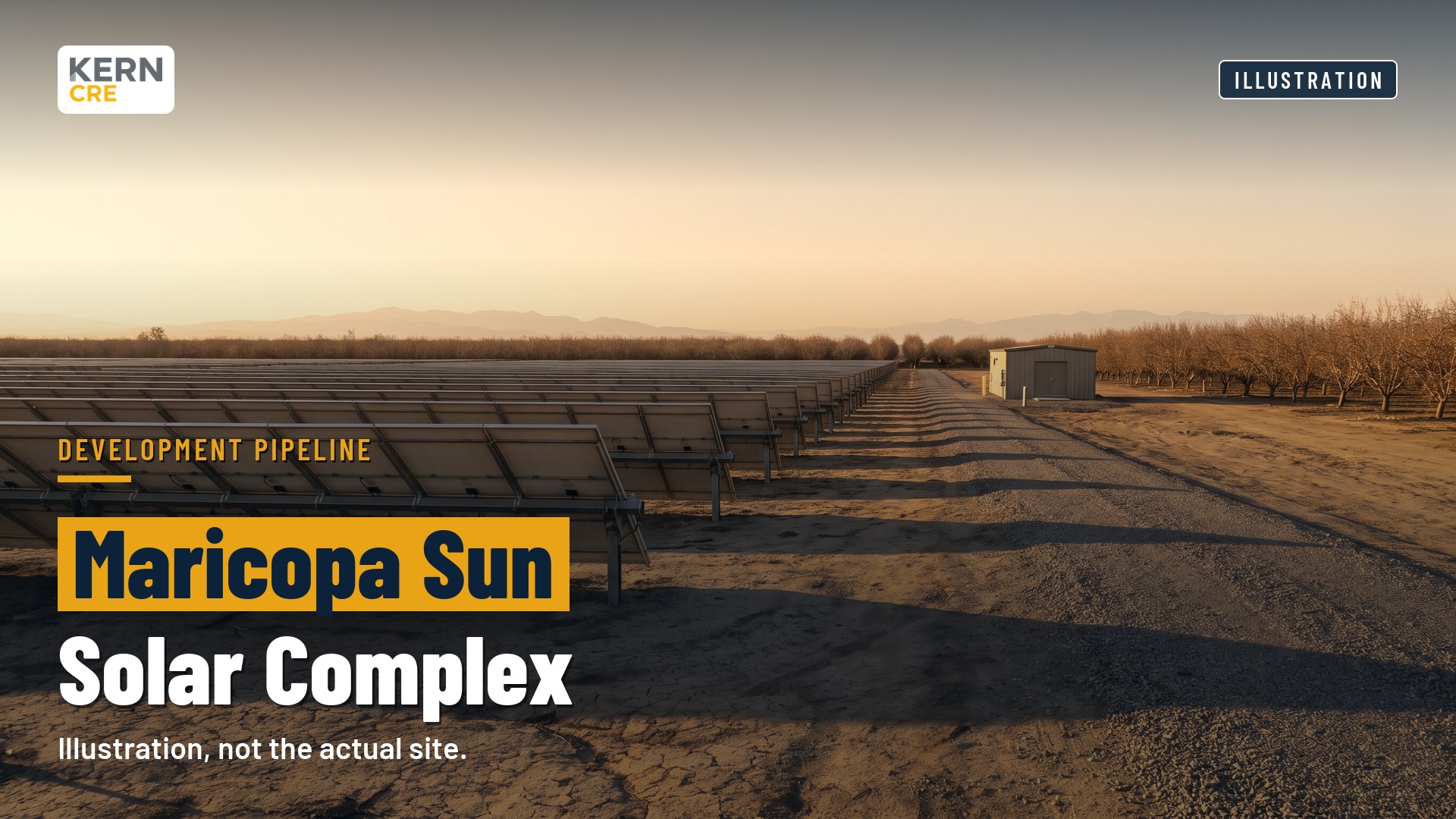
What the state’s Sept. 24 amendment covers, how a 700 MW project approved in 2011 has evolved, and what it signals for Westside farmland and Kern’s solar pipeline.
The Maricopa Sun Solar Complex is a 700-megawatt (MW) solar project on idle farmland along South Lake Road near Taft in Kern County, California. Kern County approved it March 29, 2011. On Sept. 24, 2026, the California Department of Fish and Wildlife approved Minor Amendment No. 8 to its state wildlife permit, which clarifies biologist duties and extends mitigation deadlines.
Key takeaways
- The California Department of Fish and Wildlife (CDFW) approved Minor Amendment No. 8 to the project’s incidental take permit on Sept. 24, 2026. It clarifies biologist duties, updates contacts and extends mitigation deadlines.
- Kern County supervisors approved the project March 29, 2011: 700 MW on 6,046 acres, plus a program-level 345 MW on 2,960 acres.
- The state permit covers a 3,856.1-acre solar facility and permanent conservation of 5,692.6 acres of on-site and nearby off-site land.
- E.ON Solar announced completion of its 20 MW Maricopa West facility, built on land it bought within the complex, on Nov. 4, 2015.
- The state permit has been amended eight times since 2014. A 2022 change extended its expiration by five years and placed battery storage within the original footprint.
Maricopa Sun Solar Complex at a glance
| Item | Detail |
|---|---|
| Project | Maricopa Sun Solar Complex |
| Location | North and south sides of South Lake Road, east of Gardner Field Road and northeast of Copus and Schallock roads, about 5 miles from Taft, unincorporated southwest Kern County |
| Applicant/owner | Maricopa Sun, LLC (county, state and federal permits); Maricopa East Solar PV, LLC (2015 addendum); E.ON Solar bought land within the complex for Maricopa West (2015) |
| Jurisdiction | Kern County (land use); California Department of Fish and Wildlife (state take permit); U.S. Fish and Wildlife Service (federal habitat conservation plan) |
| Case numbers | EIR 03-09; PP10216; SCH 2010031034; GPA 5 (Map 158), GPA 1 (Map 159); CUP 5 (Map 158), CUP 7 (Map 159), CUP 16 (Map 160); CDFW ITP 2081-2014-060-04; federal permit TE54164B-0 |
| Size | 700 MW approved in 2011 (plus 345 MW at program level); 3,856.1-acre solar facility and 5,692.6 acres of conservation land in the state permit |
| Use | Photovoltaic solar with on-site distribution lines; battery storage within the original footprint (2022 amendment) |
| Status | Entitled since 2011; 20 MW Maricopa West phase completed 2015; CDFW Minor Amendment No. 8 approved Sept. 24, 2026 |
| Next step | Complete mitigation under extended timeframes; no county hearing scheduled |
What did CDFW approve for the Maricopa Sun Solar Complex?
CDFW approved a minor, mostly housekeeping amendment to the project’s state permit. On Sept. 24, 2026, it signed Minor Amendment No. 8 to incidental take permit No. 2081-2014-060-04, issued under the California Endangered Species Act. The State Clearinghouse received CDFW’s Notice of Determination the next day.
The amendment changes several conditions of approval. It clarifies the duties of the designated biologists, updates contact information, extends the deadline for certain mitigation requirements and makes formatting edits. No new Kern County entitlement was involved.
The permit covers three state-listed species: the San Joaquin kit fox, the San Joaquin antelope squirrel and the Tipton kangaroo rat. CDFW describes the permitted project as a 3,856.1-acre photovoltaic plant with on-site distribution lines, plus permanent conservation of 5,692.6 acres.
How has the Maricopa Sun Solar Complex changed since 2011?
The project has gained federal and state wildlife permits, four county environmental addenda and eight state permit amendments since its 2011 approval.
The 2011 county approval
Kern County began environmental review with a Notice of Preparation in March 2010 and filed the environmental impact report (EIR) with the state in November 2010, the CEQAnet project record shows. The Planning Commission heard the project on March 10, 2011, according to the county’s project page.
On March 29, 2011, the Board of Supervisors certified the Final EIR and approved 700 MW on a 6,046-acre site, plus a program-level 345 MW of future expansion on a 2,960-acre site, according to a 2015 EIR addendum. The approval included General Plan Amendment No. 5 (Map 158), GPA No. 1 (Map 159) and Conditional Use Permits No. 5 (Map 158), No. 7 (Map 159) and No. 16 (Map 160).
The county has since prepared four EIR addenda, dated February 2014, February 2015, April 2018 and November 2018. The 2015 addendum covered a franchise for a pole-line transmission system and named PG&E’s Lakeview Substation as the point of interconnection.
Federal and state wildlife permits
On Dec. 8, 2014, the U.S. Fish and Wildlife Service announced it would issue Maricopa Sun, LLC a permit for a 700 MW facility covering 5,784.3 acres, with a 35-year habitat conservation plan (HCP). The plan covers the blunt-nosed leopard lizard, Tipton kangaroo rat and San Joaquin kit fox, plus the western burrowing owl and Nelson’s antelope squirrel, per the Federal Register.
The conservation design is unusual. FWS said 1,894.4 acres of existing habitat would be permanently conserved, and conservation easements would cover 3,798.2 acres, the same acreage the federal notice lists for the solar sites. That makes 5,692.6 acres in all, the same total CDFW cites in 2026. The easements allow solar development, operation and decommissioning during the 35-year term, followed by habitat management in perpetuity.
In June 2022, FWS published notice that Maricopa Sun, LLC had applied to extend the permit from 35 to 50 years and add Kern mallow as a covered species. The request would also remove 489.9 acres of potential solar development and add battery energy storage as a covered activity, leaving a plan area of 5,318.4 acres. No federal decision on that request has been published.
Eight state permit amendments in 12 years
CDFW issued the state permit in December 2014 and has amended it eight times since, per the CEQAnet record.
| Date (approval or filing) | State permit action |
|---|---|
| Dec. 2014 | Incidental take permit approved (notice received Dec. 18, 2014) |
| Feb. to March 2015 | Minor Amendments No. 1, 2 and 3 |
| Dec. 2016 | Minor Amendment No. 4 |
| Dec. 9, 2019 | Major Amendment No. 5: defines the Bitterwater Switching Station and shifts 24 acres of mitigation from on-site easements to off-site land |
| Oct. 24, 2022 | Major Amendment No. 6 (reissued Dec. 2022): extends the permit’s expiration by five years, places battery storage within the original footprint, adds a performance security option |
| May 14, 2024 | Major Amendment No. 7: adds construction of new collector lines, the Hill Crossing and C&A Farms Crossing |
| Sept. 24, 2026 | Minor Amendment No. 8: biologist duties, contacts, extended mitigation timeframes |
Where is the Maricopa Sun Solar Complex, and what was the land before?
The project sits along South Lake Road, about 5 miles from Taft, on land that had lost its irrigation water. CDFW’s notice places it on both sides of South Lake Road, east of Gardner Field Road and northeast of Copus and Schallock roads, in unincorporated southwest Kern County. The sources differ on direction: CDFW’s notice says about 5 miles west of Taft, while the project’s May 2022 habitat conservation plan says about 5 miles east along South Lake Road. The road names are the safer guide.
The county’s 2015 addendum said most project-level parcels had not been farmed for at least eight years, and that a lack of irrigation water limits farming. The 2022 plan says the permit area is zoned for agriculture, the sites are disked repeatedly for weed control, and enough water for financially viable farming is not available.
That idle ground is also habitat. Listed species use it, so every phase of the project runs through wildlife agencies as well as the county.
Who is behind the Maricopa Sun Solar Complex?
Maricopa Sun, LLC is the applicant on the county and CDFW records and on the federal permit. County, state and federal records name no parent company. An entity named Maricopa East Solar PV, LLC applied for the 2015 transmission franchise addendum.
The complex is being built in pieces, and not all by Maricopa Sun. On Nov. 4, 2015, E.ON Solar announced completion of its 20 MW (AC) Maricopa West facility on land it bought within the complex, which the release called a 4,000-acre solar park near Taft. In that release, Jeff Roberts of Maricopa Sun said the team worked closely with both wildlife agencies “to get to the point of a shovel ready project.”
The 2022 habitat plan says construction of the first solar development began in 2015 after the permit was issued, and that one site is partially developed with an active solar facility. Public records do not show how much of the approved 700 MW operates today or name a power buyer for the rest.
What does the Maricopa Sun Solar Complex mean for Kern County’s solar and land market?
The project’s record shows how a 2011 entitlement has been amended as the grid changed, and what converting idle farmland has involved.
An old entitlement in a fast-moving market
Kern is still approving large plants. In 2026, supervisors approved Terra-Gen’s Discovery Solar project, up to 1,400 MW and 8 GWh of storage on about 7,700 acres, on June 16 (CEQAnet). They approved its Galaxy Solar project, up to 600 MW and 4 GWh on about 3,519 acres, on Sept. 29 (CEQAnet). Both are desert sites in East Kern. Maricopa Sun is a Westside farmland site approved 15 years earlier.
The grid has changed around it. From April 2024 to April 2026, utility-scale solar capacity in the California ISO grid grew 19% to 25 gigawatts and battery capacity grew 79% to 16 GW, the U.S. Energy Information Administration reported. Solar out-generated natural gas on 82% of days in the first five months of 2026.
CDFW’s Major Amendment No. 6, approved Oct. 24, 2022, allows battery storage within the original project footprint. For the economics of solar and storage projects, see our guides to the federal solar tax credit for commercial projects and NEM 3.0 commercial solar.
Tax timing
California’s property tax exclusion for new solar energy systems covers systems built before Jan. 1, 2027. SB 710 lets those systems keep the break until the property changes ownership, according to Sen. Catherine Blakespear’s office. Any Maricopa Sun capacity installed after 2026 would not qualify, so that equipment would count toward Kern’s property tax roll.
What Westside landowners can take from it
Solar is one of the few uses left for farmland that has lost its water. Shannon Eddy of the Large-Scale Solar Association told 23ABC in May 2025 that solar is “one of the few things you can actually put on fallowed ag land to restore revenue.”
Maricopa Sun’s path has included years of county, federal and state review, and conservation easements that stay with the land.
What happens next for the Maricopa Sun Solar Complex?
No county hearing is scheduled, because the amendment is an administrative state action. CDFW’s notice opens the window to challenge it under the California Environmental Quality Act, generally 30 days from filing.
Open items include the mitigation work the amendment gave more time for, a federal decision on the 2022 HCP amendment if one has not been issued, and any announcement of a power buyer, battery storage or construction on the remaining sites. The Bitterwater Switching Station and the Hill Crossing and C&A Farms Crossing collector lines, added through permit amendments since 2019, are the infrastructure in play.
Frequently asked questions
What is the Maricopa Sun Solar Complex?
It is a photovoltaic solar project by Maricopa Sun, LLC on idle farmland along South Lake Road near Taft in southwest Kern County. The county approved 700 MW on 6,046 acres on March 29, 2011, plus a program-level 345 MW. State permits describe a 3,856.1-acre solar facility with 5,692.6 acres of permanent conservation land.
What did CDFW’s Minor Amendment No. 8 change?
The Sept. 24, 2026 amendment to state permit No. 2081-2014-060-04 clarifies the duties of designated biologists, updates contacts and gives more time to finish certain mitigation. It also makes formatting edits. The project’s size did not change, and no new county approval was needed.
Where is the Maricopa Sun Solar Complex located?
It sits on both sides of South Lake Road, east of Gardner Field Road and northeast of Copus and Schallock roads, about 5 miles from Taft. Sites also run along Copus Road. The county’s 2015 addendum names PG&E’s Lakeview Substation as the interconnection point.
Has any of the Maricopa Sun Solar Complex been built?
Yes, at least one phase. E.ON Solar said Nov. 4, 2015 that its 20 MW Maricopa West facility was complete. The 2022 habitat plan also reports an active solar facility on one site. Public records do not show how much of the 700 MW operates today.
Why does a solar project near Taft need endangered species permits?
The idle farmland is habitat for protected animals. The state permit covers the San Joaquin kit fox, San Joaquin antelope squirrel and Tipton kangaroo rat, and the federal plan adds the blunt-nosed leopard lizard, western burrowing owl and Nelson’s antelope squirrel. In return, the project conserves 5,692.6 acres, including easements on the solar sites that allow solar use during the permit term.
Does the Maricopa Sun Solar Complex include battery storage?
On paper, yes. CDFW’s Major Amendment No. 6, approved Oct. 24, 2022, allows battery storage within the original project footprint, and the owner asked federal regulators the same year to add it as a covered activity. No battery capacity, buyer or construction date has been announced.
Own idle farmland on the Westside, or weighing a solar lease or sale near Taft? We can talk through what an existing habitat plan or easement means for your property’s value. Call Kern CRE at 855-KERN-CRE (855-537-6273) or contact us. Get Kern County CRE news monthly: subscribe to the Kern CRE report.
Sources
- Maricopa Sun Solar Complex Project, CESA Incidental Take Permit No. 2081-2014-060-04, Minor Amendment No. 8, Notice of Determination, CEQAnet (Governor’s Office of Land Use and Climate Innovation), received Sept. 25, 2026.
- Notice of Determination, Minor Amendment No. 8 (signed PDF), California Department of Fish and Wildlife, Sept. 24, 2026.
- SCH 2010031034 document list, CEQAnet.
- ITP Major Amendment No. 7, Notice of Determination, CEQAnet, received May 15, 2024.
- ITP Major Amendment No. 6, Notice of Determination, CEQAnet, received Oct. 27, 2022.
- ITP Major Amendment No. 5, Notice of Determination, CEQAnet, received Dec. 9, 2019.
- Maricopa Sun Solar Complex Project, Kern County Planning and Natural Resources Department.
- Addendum II to the EIR for the Maricopa Sun Solar Complex Project, Kern County Planning and Natural Resources Department, February 2015.
- Maricopa Sun Solar Complex in Kern County to be Issued Endangered Species Permit, U.S. Fish and Wildlife Service, Dec. 8, 2014.
- Draft Environmental Impact Statement and Proposed Maricopa Sun Solar Complex Multi-Species Habitat Conservation Plan, Federal Register, May 28, 2014.
- Maricopa Sun Solar Complex Habitat Conservation Plan, Kern County, California; Environmental Assessment, Federal Register, June 21, 2022.
- Maricopa Sun Solar Complex Project Habitat Conservation Plan, Maricopa Sun, LLC via Regulations.gov, May 2022.
- E.ON Solar Announces the Completion of the Maricopa West Facility, E.ON Solar via PR Newswire, Nov. 4, 2015.
- Solar on Ag Land: As Water dries up, solar moves in across the Central Valley, 23ABC News (KERO), May 12, 2025.
- Solar generation in CAISO surpassed natural gas in the first five months of 2026, U.S. Energy Information Administration, June 16, 2026.
- Sen. Blakespear’s legislation to protect solar tax incentive signed by Governor (SB 710), Office of Sen. Catherine Blakespear, Oct. 6, 2025.
- Discovery Solar PV and Storage Project, Notice of Determination, CEQAnet, received June 18, 2026.
- Galaxy Solar PV and Storage Project, Notice of Determination, CEQAnet, received Oct. 1, 2026.
About this article
Kern CRE prepared this article with help from AI research and writing tools. An editor reviewed the draft, checked its facts against the sources linked above and edited it for accuracy and clarity. Details come from public records and the sources cited; unless stated, Kern CRE and ASU Commercial were not involved in the transaction or project.