
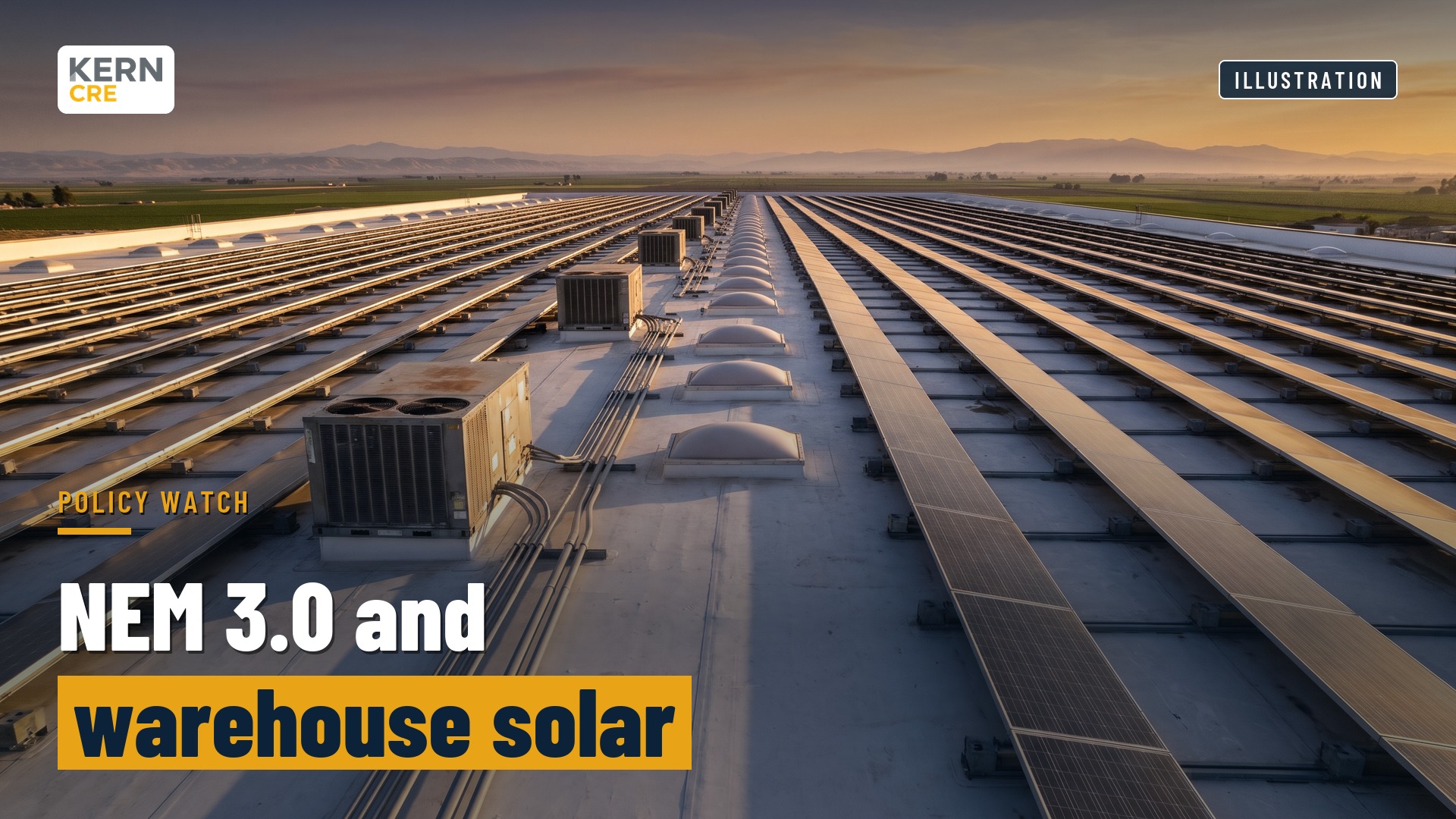
California’s Net Billing Tariff pays far less for exported power than the old rules. For Kern County buildings, the answer now depends on daytime load, batteries and who owns the system under the lease.
NEM 3.0 commercial solar is shorthand for California’s Net Billing Tariff, which the California Public Utilities Commission (CPUC) adopted in Decision 22-12-056 on Dec. 15, 2022. It covers solar customers who applied to interconnect on or after April 15, 2023. Exported power earns hourly “avoided cost” values instead of retail-based credits, so systems sized to on-site daytime load, often with batteries, perform best. The tariff remains in effect.
NEM 3.0 for commercial customers at a glance
| Item | Detail |
|---|---|
| Policy | Net Billing Tariff (NBT), commonly called NEM 3.0 |
| Adopted by | California Public Utilities Commission, Decision 22-12-056 |
| Adopted | Dec. 15, 2022; adopted with minor modifications by Resolution E-5301 on Nov. 30, 2023 |
| Applies to | Customers submitting interconnection applications on or after April 15, 2023 |
| Export credit | Hourly Avoided Cost Calculator values, locked in for nine years for applications completed through Dec. 31, 2027 (PG&E tariff) |
| Commercial rate | Non-residential customers may use any open applicable time-of-use rate |
| Kern utilities | Pacific Gas and Electric (PG&E) serves Bakersfield and much of the county; Southern California Edison (SCE) serves parts of eastern Kern. |
| Status | In effect; PG&E’s NBT schedule last revised effective Aug. 28, 2026 |
| What to watch | Federal Section 48E in-service deadline of Dec. 31, 2027; end of the nine-year lock-in window after 2027 |
Key takeaways
- The CPUC adopted the Net Billing Tariff on Dec. 15, 2022, and it governs solar customers who applied to interconnect on or after April 15, 2023.
- Under PG&E’s NBT schedule, exports are credited at hourly Avoided Cost Calculator values locked in for nine years for applications completed through Dec. 31, 2027.
- PG&E’s tariff limits the ACC Plus export adder to residential customers, so commercial customers do not get it.
- California industrial customers paid an average of 21.64 cents per kWh in the 12 months ended June 2026, which makes self-consumed solar far more valuable than exported solar.
- A solar project that begins construction after July 4, 2026 must be in service by Dec. 31, 2027 to claim the federal Section 48E credit.
What is NEM 3.0, and how does it apply to commercial solar?
NEM 3.0 is the Net Billing Tariff, and it applies to commercial customers as much as residential ones. Net energy metering (NEM) lets a customer with solar offset its bill with power sent to the grid. On Dec. 15, 2022, the CPUC replaced NEM 2.0 with the Net Billing Tariff for customers who submit an interconnection application on or after April 15, 2023, and it made minor modifications through Resolution E-5301 on Nov. 30, 2023.
Warehouses, manufacturers, retail centers and offices that add solar after the cutoff take service on the NBT. Customers already on NEM 2.0 stay on it for 20 years from the year their system was first interconnected, according to PG&E’s Schedule NEM2. That eligibility stays with the system if the property or account changes hands, as long as the system stays at its original location. A building’s solar history therefore matters in due diligence.
The tariff has also faced court challenges. A California Court of Appeal upheld it on March 9, 2026, according to Law of Renewable Energy.
How does the Net Billing Tariff credit commercial solar exports?
Each exported kilowatt-hour earns the avoided cost value for that hour, and each kilowatt-hour the building uses as it is produced avoids the full retail energy charge. PG&E’s Electric Schedule NBT sets the mechanics for most of Kern County. The table covers the main features for a non-residential customer.
| Feature | How it works under NBT (PG&E schedule) |
|---|---|
| Export credit | Each exported kWh is multiplied by the hourly avoided cost value from the CPUC’s Avoided Cost Calculator |
| Lock-in | Hourly export values are locked in on a nine-year schedule for applications completed April 15, 2023 through Dec. 31, 2027; afterward, averaged hourly values apply |
| ACC Plus adder | Residential only; non-residential customers are not eligible |
| Rate schedule | Non-residential customers may take any open applicable time-of-use rate |
| Non-bypassable charges | Paid on every kWh imported from the grid, including public purpose, nuclear decommissioning, competition transition and wildfire fund charges |
| True-up | Twelve-month period; excess export credits carry forward; net surplus compensation uses a rolling average of PG&E’s default load price from 7 a.m. to 5 p.m. |
| System size | Up to 150% of the last 12 months of usage, or of estimated usage for new construction, if the customer attests to expected load growth within 12 months of permission to operate |
| Aggregation (NBTA) | One system can serve multiple meters on the same, adjacent or contiguous property solely owned, leased or rented by the customer; $25 setup per aggregated account (capped at $500) plus $5 per account per month |
| Batteries | Paired storage over 10 kW that is directly connected must meet no-export requirements through a certified power control system or non-export relay |
The practical result is simple. Exports in the middle of a sunny day generally earn far less than the retail rate the building would otherwise pay, so oversizing a system to export is rarely the goal under NBT. That is our general characterization, not a quoted tariff value. SCE and San Diego Gas & Electric follow the same CPUC decision, but each has its own rates and tariff sheets.
Does NEM 3.0 commercial solar still pencil in Kern County?
It often does, but the building’s load profile decides. California industrial customers paid an average of 21.64 cents per kWh, and commercial customers 26.90 cents, in the 12 months ended June 2026, the highest among the contiguous states, according to EIA data compiled by the Center for Jobs and the Economy. High retail rates make every self-consumed solar kilowatt-hour valuable.
A 2022 national brokerage analysis found onsite solar could offset an industrial electric bill by up to 95% in many cases and that lower energy costs can “encourage tenants to sign longer lease agreements.” That analysis predates the NBT. In a Feb. 26, 2026 release, another national brokerage said power availability, reliability and cost are “increasingly shaping site selection, development feasibility and asset performance.”
| Building and user | Daytime load | Likely outcome under NBT |
|---|---|---|
| Bulk distribution warehouse, light lighting and HVAC | Low | Large roof, little load; size to load or pair with batteries; exports earn low values |
| Cold storage or food processing | High and steady | Strong fit; most output used on site |
| Manufacturing with daytime shifts | High | Strong fit; demand charge savings come on top |
| Multi-tenant industrial park, one owner | Mixed | Aggregation works only for meters held by the same customer; separate tenants need separate arrangements |
| Retail center with tenant meters | Varies by tenant | Landlord system often serves common-area meters; tenant offtake needs a power purchase agreement (PPA) or similar structure |
Table: Kern CRE analysis.
Why do batteries matter more under NEM 3.0?
Batteries let a building store midday output and use it later instead of exporting it cheaply. They can also trim peak demand, which solar alone does not reliably do when clouds or late-day load spikes hit. Under PG&E’s tariff, directly connected batteries over 10 kW generally must not export, so owners size them to serve the building. Federal credits for storage also last longer than those for solar. For a look at the grid side of this decision, see our guide to industrial building power requirements and our explainer on SB 410 energization timelines.
How do federal credits and property tax rules affect the decision?
Timing now drives the math. Under the One Big Beautiful Bill Act, a solar facility that begins construction after July 4, 2026 must be placed in service by Dec. 31, 2027 to claim the Section 48E credit, according to The Tax Adviser. Battery storage keeps its credit for construction starting through 2033. Our commercial solar tax credit guide covers the details.
California’s property tax exclusion for active solar energy systems covers systems installed before Jan. 1, 2027, and SB 710 lets those owners keep it until the property sells, according to the office of Sen. Catherine Blakespear. A system finished in 2026 gets both the federal credit and the exclusion. One finished in 2027 may get the credit but faces reassessment of the new construction unless the law changes.
In Kern County, the county has also approved accessory solar sized for an industrial user’s own load, such as a 1,477 kW array near Mojave approved in July 2026. See our report on the MAG Energy solar project in Mojave and the CEQAnet record. New buildings may also face solar and battery rules under Title 24, which we cover in a separate article.
Who should own the system under a NNN lease?
In a NNN lease the tenant usually holds the utility account, so the tenant is the NBT customer even if the landlord owns the roof. The ownership structure has to match who pays the bill and who benefits. Our guide to NNN, modified gross and full-service leases explains who pays what.
| Structure | Who owns and benefits | Lease points to negotiate |
|---|---|---|
| Tenant-owned | Tenant installs, owns the system and keeps savings and credits | Landlord consent, roof warranty protection, insurance, removal or surrender at lease end |
| Landlord-owned, tenant meter | Landlord funds the system; tenant’s bill drops | How the landlord recovers cost (higher rent or a defined charge), maintenance, what happens on vacancy; any per-kWh charge raises utility-regulation questions |
| Third-party PPA | Developer owns the system; tenant buys power at a contract rate | Term versus lease term, assignment on sale, roof access, removal security |
| Roof lease | Landlord leases roof space to a developer | Roof rent, access, roof replacement coordination, and whether the power can serve the building |
Selling power to a tenant by the kilowatt-hour can raise utility-regulation questions.
Line up solar terms with the lease term. A 20-year PPA on a building with a five-year lease needs clear assignment and removal language. Buyers of solar-equipped buildings typically collect the interconnection agreement, the tariff (legacy NEM or NBT), production data and any PPA or roof lease.
What if the Kern County building you are buying or leasing already has solar?
An existing system can be an asset or a headache, and the tariff it sits on is the first question. Under PG&E’s NEM 2.0 schedule, exports are valued at the same time-of-use price the customer pays for power, for 20 years from the original interconnection year, and that status survives a sale if the system stays in place. That is usually worth more than NBT treatment. A system that applied on or after April 15, 2023 is on the NBT, with a nine-year schedule of hourly export values locked in if its application was completed by the end of 2027.
Ask the seller or landlord for these items:
- the permission-to-operate letter and the interconnection agreement
- 12 months of production and billing data
- the inverter and battery warranties, and any roof warranty conditions tied to the array
- proof of who owns the equipment, and whether a PPA or roof lease is recorded against the property
Whether the system can stay in service if the roof needs replacement during a hold also matters. For a tenant, an existing landlord-owned array should show up in the lease as either a rent component or a defined energy benefit. If the system will be removed or is near the end of its useful life, the lease should settle who pays.
What deadlines and steps matter for commercial solar?
- Dec. 31, 2027: the last date for NBT applications to lock in nine-year export values under PG&E’s tariff, and the federal in-service deadline for solar that begins construction after July 4, 2026.
- Jan. 1, 2027: California’s solar property tax exclusion ends for new installations unless extended.
- Avoided Cost Calculator updates: new values affect export credits for later applicants.
- Checklist: a typical project starts with 12 months of interval data, the PG&E or SCE service and rate schedule, daytime load sizing, a battery model, interconnection queue timing, roof condition and structural capacity, and an ownership decision under the lease. A solar consultant can run the numbers on current tariffs.
Worked example: a 500 kW rooftop system on two Kern buildings
Assume a 500 kW system produces about 800,000 kWh a year, the avoided retail energy charge averages 20 cents per kWh and exports average 5 cents per kWh. All three figures are illustrative assumptions, not tariff rates. Actual values vary by hour, rate schedule and season.
The same array is worth about 38% more to the high-load user, before any battery. For the low-load warehouse, adding storage to shift midday output into later hours is how the economics improve.
| Building | Used on site | Exported | Value of on-site use | Value of exports | Total |
|---|---|---|---|---|---|
| Distribution warehouse, low load | 480,000 kWh (60%) | 320,000 kWh | $96,000 | $16,000 | $112,000 |
| Manufacturer, high daytime load | 760,000 kWh (95%) | 40,000 kWh | $152,000 | $2,000 | $154,000 |
Frequently asked questions
What is NEM 3.0 for commercial solar?
NEM 3.0 is the common name for California’s Net Billing Tariff. Commercial customers that applied to interconnect solar on or after April 15, 2023 take service on it. Exports earn hourly avoided cost values rather than retail-based credits, and non-residential customers can choose any open applicable time-of-use rate.
Is commercial solar still worth it under NEM 3.0?
It can be, especially where most output is used during the day, as in cold storage, food processing and manufacturing. With California industrial power averaging 21.64 cents per kWh in the 12 months ended June 2026, every purchased kilowatt-hour avoided has real value. Low-load warehouses usually need smaller systems or batteries to make the numbers work.
Do commercial customers get the ACC Plus adder?
No. PG&E’s tariff limits the ACC Plus export adder to residential customers who interconnect during the tariff’s first five years. Commercial exports earn only the hourly Avoided Cost Calculator values.
Can one solar system serve several meters on a commercial property?
Yes, under Net Billing Tariff aggregation (NBTA), if the meters sit on the same, adjacent or contiguous property and the same customer solely owns, leases or rents all of them. PG&E charges a $25 setup fee per aggregated account, capped at $500, plus $5 per account per month. Meters held by different tenants cannot simply be combined.
Should I add a battery to commercial solar under NEM 3.0?
Often, yes. A battery holds midday output for later hours instead of exporting it at low values, and it can cut peak demand charges. Under PG&E’s tariff, directly connected batteries over 10 kW generally cannot export to the grid.
Who owns rooftop solar on a leased warehouse?
It depends on the deal. A tenant can own the system with landlord consent, a landlord can fund it and recover the cost through rent, or a third party can own it and sell power under a PPA. Because the tenant usually holds the utility account in a NNN lease, the lease should address consent, roof warranties, insurance, removal and assignment.
What deadlines matter for commercial solar in 2026 and 2027?
Federal Section 48E credit eligibility requires solar that begins construction after July 4, 2026 to be in service by Dec. 31, 2027. California’s solar property tax exclusion covers systems installed before Jan. 1, 2027. Under PG&E’s tariff, applications completed through Dec. 31, 2027 lock in nine years of hourly export values.
Weighing solar on a Kern County building you own, lease or plan to buy? Call Kern CRE at 855-KERN-CRE (855-537-6273) or contact us to sort out how it affects rent, lease terms and value. Get Kern County CRE news monthly: subscribe to the Kern CRE report.
Sources
- California Public Utilities Commission, Net Billing Tariff, CPUC.
- Pacific Gas and Electric Company, Electric Schedule NBT, Net Billing Tariff (Advice 7975-E), PG&E, effective Aug. 28, 2026.
- Center for Jobs and the Economy, California Energy Price Data for August 2026 (EIA data), Sept. 16, 2026.
- Pacific Gas and Electric Company, Electric Schedule NEM2, Net Energy Metering Service, PG&E.
- Regional brokerage market reports (industrial, Nov. 11, 2022).
- Regional brokerage market reports (Feb. 26, 2026).
- Lynn Mucenski-Keck, Navigating safe-harbor rules for solar and wind Sec. 48E facilities, The Tax Adviser (AICPA), Feb. 10, 2026.
- Office of Sen. Catherine Blakespear, Sen. Blakespear’s legislation to protect solar tax incentive signed by Governor, Oct. 6, 2025.
- CEQAnet (State Clearinghouse), MAG Energy accessory solar, Notice of Exemption, SCH 2026070647, July 16, 2026.
- Law of Renewable Energy, The California Court of Appeal Rules in Favor of the CPUC’s Net Billing Tariff, March 2026.
About this article
Kern CRE prepared this article with help from AI research and writing tools. An editor reviewed the draft, checked its facts against the sources linked above and edited it for accuracy and clarity. It is general information on California’s Net Billing Tariff and related rules, not legal, tax, investment or financial advice; talk with a qualified professional, such as a solar consultant, CPA or attorney, before you invest in a system or sign a PPA or roof lease.