
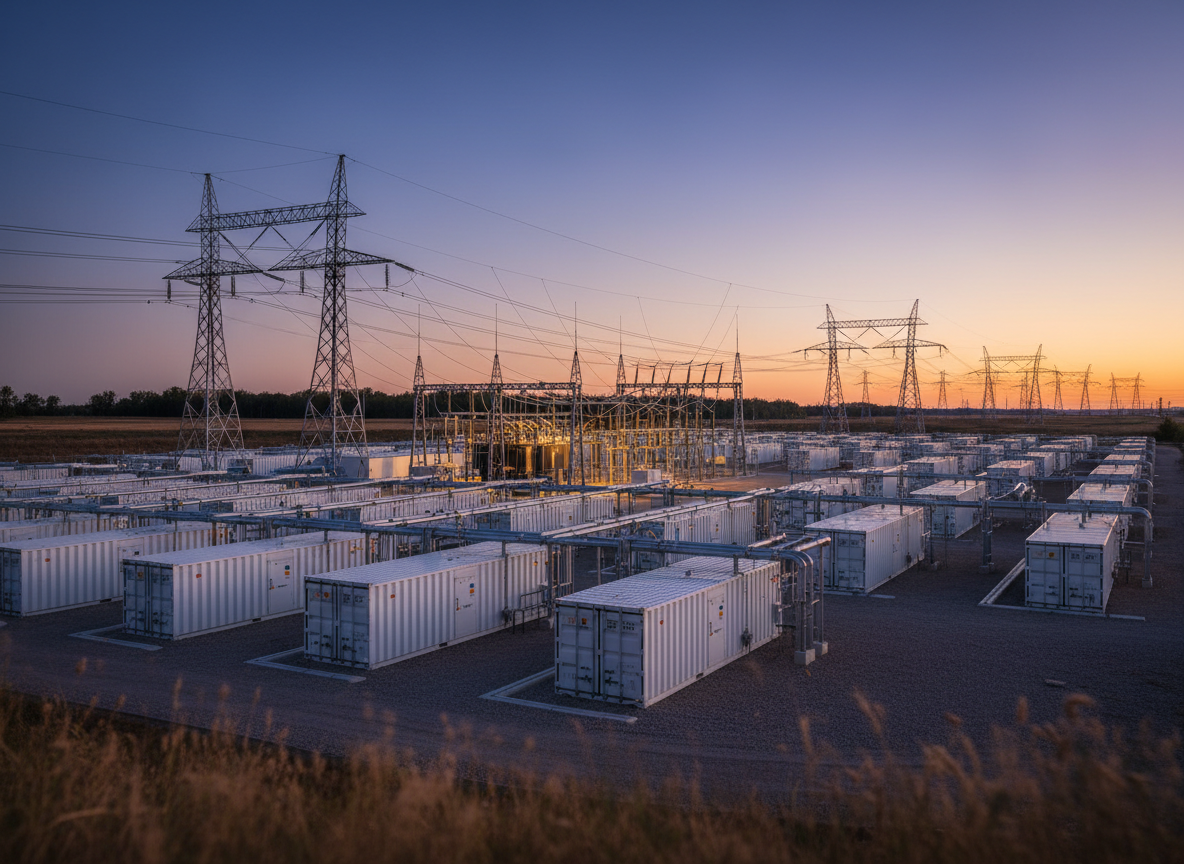
California answered the January 2025 Moss Landing fire with new fire-department reviews, inspections and utility standards. Here is what applies to the big storage projects planned across East Kern.
The battery energy storage regulations California adopted after the Jan. 16, 2025 Moss Landing fire center on SB 283 (Laird), signed Oct. 6, 2025 and effective Jan. 1, 2026. It requires developers to meet local fire officials at least 30 days before applying and to pass a fire inspection before operating. The California Public Utilities Commission’s General Order 167-C adds maintenance and emergency-plan standards. Kern County projects near Rosamond and Mojave now follow these rules.
California battery storage rules at a glance
| Item | Detail |
|---|---|
| Main new law | Senate Bill 283 (Laird), Clean Energy Safety Act of 2025, Chapter 407, Statutes of 2025 |
| Signed / effective | Signed Oct. 6, 2025; effective Jan. 1, 2026 |
| Other 2025 laws | SB 254 (changes to the AB 205 opt-in, signed Sept. 19, 2025); AB 1285 (State Fire Marshal best practices, signed Oct. 11, 2025) |
| Utility regulator rule | CPUC General Order 167-C, adopted March 13, 2025: maintenance, operation and emergency-plan standards |
| Earlier law | SB 38 (Laird, 2023): every battery facility needs an emergency response plan and an emergency action plan |
| Local enforcement in unincorporated Kern County | Kern County Fire Department permits and inspections; Kern County Planning for land use permits and CEQA |
| Did not pass | AB 303 (3,200-foot setbacks) died in committee in 2025; AB 434 (moratorium) did not advance |
| Status | SB 283 in effect; State Fire Marshal review of NFPA 855 for later code cycles; Moss Landing debris reignited Sept. 18, 2026 |
| What to watch | Euismod storage hearing Oct. 22, 2026; new fire code provisions; any 2027 bills after the September 2026 flare-up |
Key takeaways
- SB 283 requires storage developers to meet and confer with the local fire department at least 30 days before submitting an application. They must also pass a fire inspection, at their own cost, before operating.
- The CPUC adopted General Order 167-C on March 13, 2025. It adds maintenance, operation, logbook and emergency-plan standards for battery storage facilities.
- California has no statewide battery setback. AB 303, which proposed 3,200-foot buffers from sensitive receptors, died in committee in 2025.
- Kern County Fire Department guidance bars batteries above 50% state of charge from a site until fire protection systems are commissioned and accepted.
- California passed 21,000 megawatts (MW) of battery capacity in August 2026, according to the California Energy Commission, and East Kern hosts several of the largest proposals.
What happened at Moss Landing, and why did it change battery energy storage regulations California applies?
A fire at Vistra’s 300 MW Phase I battery facility in Monterey County on Jan. 16, 2025 pushed lawmakers and regulators to act. The batteries ignited inside a concrete hall, burned for hours and forced local evacuations, according to the Assembly Utilities and Energy Committee’s analysis of SB 283. The same analysis lists earlier incidents at the site in 2021 and 2022, including a 2022 fire at PG&E’s neighboring 182 MW facility that smoldered for five hours.
The problem did not end in 2025. On Sept. 18, 2026, about 1,200 still-charged battery modules ignited in the burned remains. Monterey County issued a shelter-in-place order that morning and lifted it that afternoon, CalMatters reported.
The fire came during a storage boom. The Assembly analysis says utility-scale storage grew from about 250 MW in 2019 to nearly 12,000 MW by mid-2025, with a projected need of 52,000 MW by 2045. In August 2026 the California Energy Commission said the state had passed 21,000 MW of battery resources.
What do California’s battery storage laws and rules now require?
The current framework stacks statutes, a CPUC general order and the fire code. The table summarizes each piece.
| Rule | Status | What it requires | Who enforces |
|---|---|---|---|
| SB 283 (Laird), Ch. 407, Stats. 2025 | Signed Oct. 6, 2025; effective Jan. 1, 2026 | Meet and confer with the fire authority at least 30 days before applying; fire inspection before operation at the applicant’s cost; State Fire Marshal review of NFPA 855 for code cycles after July 1, 2026 | Local fire department or State Fire Marshal; permitting agency |
| CPUC General Order 167-C | Adopted March 13, 2025 | Maintenance and operation standards, logbooks, emergency response and action plans, coordination with local emergency managers | CPUC inspections and enforcement |
| SB 38 (Laird, 2023) | In effect | Emergency response plan and emergency action plan covering each battery facility’s premises | Facility owner; local agencies |
| SB 254 (2025) | Signed Sept. 19, 2025 (urgency) | Streamlines California Energy Commission opt-in certification, including use of a mitigated negative declaration | California Energy Commission |
| AB 1285 (2025) | Signed Oct. 11, 2025; effective Jan. 1, 2026 | State Fire Marshal best practices; operators share incident information with emergency managers | State Fire Marshal |
| AB 303 (Addis) | Died in committee, 2025 | Would have required 3,200-foot setbacks from sensitive receptors | Not law |
| AB 434 (DeMaio) | Did not advance | Would have imposed a statewide moratorium until Jan. 1, 2028 | Not law |
Sources: LegiScan (SB 283 chapter and date); Sen. Laird’s office (effective date); Sheppard Mullin, Nov. 17, 2025 (SB 254, AB 1285, AB 303); Sheppard Mullin, March 25, 2025, and Renewable Energy World (GO 167-C); Assembly analysis (SB 38); Energy-Storage.News (AB 434).
SB 283 in detail
SB 283 adds Public Resources Code sections 25545.16 and 25545.19, per LegiScan. The bill text sets thresholds of 10 megawatt-hours (MWh) or more for locally permitted storage projects and 200 MWh or more for state-certified ones. The applicant must certify that it met with the fire authority to discuss design, risk and emergency plans, and must document that consultation. It cannot start operating until the fire department or a State Fire Marshal designee inspects the facility. The bill declares battery storage safety a statewide concern, so it applies in charter cities too.
The law also sets up the next round of code changes. It directs the Building Standards Commission and State Fire Marshal to consider the latest edition of NFPA 855, the national standard for stationary energy storage. They may propose amendments that limit indoor systems to dedicated-use, noncombustible buildings or outdoor installations. Moss Landing’s batteries sat inside a building, while most new Kern projects use outdoor enclosures.
General Order 167-C
General Order 167 governs maintenance and operation of power plants. Acting under SB 1383 (Hueso, 2022), the CPUC added battery storage standards for maintenance, operations, technical logbooks and emergency response and action plans. Local emergency managers and fire services help develop those plans, and CPUC inspections back them up.
How are battery storage projects permitted and inspected in Kern County?
In unincorporated Kern County, large projects go through the county’s land use process, and the Kern County Fire Department reviews fire safety. The county requires zone changes, conditional use permits and California Environmental Quality Act (CEQA) review by Kern County Planning and Natural Resources. A Planning Commission hearing follows, and often a Board of Supervisors vote.
Projects of 200 MWh or more can instead opt in to state certification at the California Energy Commission under AB 205, which SB 254 streamlined in 2025. Controls on county projects arrive through permit conditions, EIR mitigation and fire code review.
The Kern County Fire Department’s published permit requirements, last updated in February 2021, call for a $290 permit and large-scale fire test reports under UL 9540A. They also require a hazard mitigation analysis, separate fire protection and fire alarm permits for each battery enclosure and a dedicated fire water supply for new construction. A March 3, 2022 department letter adds three points. Plans must be sealed by a California licensed design professional. A licensed fire protection engineer the department approves must prepare the hazard analysis. No batteries above 50% state of charge may arrive on site until safety systems are commissioned and accepted.
Those documents predate SB 283 and cite the 2019 fire code numbering. Inside Bakersfield and other incorporated cities, the city’s own fire department is generally the authority SB 283 sends developers to.
Which Kern County storage projects are moving under the new rules?
East Kern’s transmission hubs near Rosamond and Mojave draw most of the county’s storage proposals. Examples from our Approvals coverage:
- Euismod Energy Storage Project, west of Rosamond: a proposed 1,150 MW, 9,200 MWh lithium-ion project next to Southern California Edison’s Whirlwind Substation. Its Draft EIR found significant and unavoidable cumulative wildfire impacts, and its preparation notice lists NFPA 855 design, automatic shutdown and an SB 38 emergency response plan, according to CEQAnet. The Planning Commission hearing is set for Oct. 22, 2026. Our Euismod project article has the details.
- Galaxy Solar near Mojave: Kern County supervisors approved up to 600 MW of solar and 4 gigawatt-hours of storage on Sept. 29, 2026, PV Tech reported. See our Galaxy Solar article.
- LADWP Beacon flow battery north of Mojave: a 50 MW, five-hour vanadium redox flow battery filed with a CEQA exemption in September 2026, per CEQAnet. Flow batteries use a water-based electrolyte rather than lithium-ion cells.
- Willow Rock near Rosamond: Hydrostor’s 500 MW, 4,000 MWh compressed-air storage project received final California Energy Commission approval in December 2025, according to Business Wire.
What do the new rules mean for Kern landowners, neighbors and investors?
For a landowner, storage usually arrives as an option and ground lease from a developer seeking land near a substation with grid capacity. SB 283 adds a fire-department step before the application and an inspection gate before operation. That time belongs in option periods and extension rights. A project that cannot pass inspection does not run, and rent tied to commercial operation will not start. Our guide to ground leases explains the structure.
There is still no statewide setback. Distance from homes, roads and other uses is set project by project through county conditions and the fire department’s review. Neighbors can comment during CEQA review and at the Planning Commission, because that is where spacing, access, water supply and emergency plans become conditions.
| Issue | Typical lease terms |
|---|---|
| Timeline | Option term long enough for fire consultation, CEQA and inspection; extension fees |
| Safety plans | Copies of the hazard mitigation analysis, SB 38 emergency plans and fire department approvals |
| Insurance | Landowner named as additional insured; pollution and fire coverage; limits that reflect the project size |
| Indemnity | Developer indemnity for fire, contamination and third-party claims, surviving lease end |
| Decommissioning | Removal of batteries and foundations, site restoration standard, and a bond or letter of credit |
| Financing | Lender consent rights and estoppels, and how a lender’s cure rights interact with safety shutdowns |
| Property tax | Who pays any increase from the improvements; see our Prop 13 reassessment guide |
Lease and diligence points for a battery storage site (Kern CRE checklist).
No major brokerage has published research on how battery storage affects Kern land values, so any claimed rent or value premium is specific to the project. For owners of nearby industrial or farm property, the practical questions are access roads, emergency response routes and whether conditions of approval address smoke and runoff.
What should Kern County watch next?
- Fire code updates: the State Fire Marshal and Building Standards Commission review of NFPA 855 for code cycles after July 1, 2026 may tighten indoor installations.
- Moss Landing findings: investigations and cleanup after the January 2025 fire and the September 2026 flare-up could drive new bills in 2027. No 2026 battery storage bill has been signed.
- Euismod hearing on Oct. 22, 2026: the first large Kern storage hearing since SB 283 took effect will show how the county handles fire consultation and wildfire findings.
- California Energy Commission opt-in: SB 254’s faster state path could pull more projects of 200 MWh or more out of county hearings.
- Federal tax credits: storage credit rules after the One Big Beautiful Bill Act affect project timing. See our solar and storage tax credit guide. Utility hookup timing matters too, as our SB 410 energization article explains.
Example: how a 400 MWh Kern storage project moves through the new rules
This hypothetical follows a 100 MW, four-hour lithium-ion project on leased land in unincorporated East Kern. The sequence reflects SB 283 and Kern County Fire’s published requirements. Timing varies by project.
| Step | Rule | What happens |
|---|---|---|
| 1. Fire consultation | SB 283 | Developer meets Kern County Fire at least 30 days before filing, covering design, risk and emergency response |
| 2. Application | County zoning or California Energy Commission opt-in (400 MWh qualifies) | Developer chooses county conditional use permit and CEQA review or state certification |
| 3. CEQA and hearings | CEQA; county conditions | EIR or mitigated negative declaration; conditions on spacing, access, water and emergency plans |
| 4. Fire permits | Kern County Fire requirements | UL 9540A test data, hazard mitigation analysis, enclosure fire protection and alarm permits |
| 5. Delivery and commissioning | Kern County Fire letter | Batteries above 50% charge not allowed on site until safety systems are accepted |
| 6. Inspection and operation | SB 283; GO 167-C | Fire inspection at developer’s cost, then operation under maintenance, logbook and emergency-plan standards |
Frequently asked questions
What is SB 283 and when did it take effect?
SB 283 is the Clean Energy Safety Act of 2025, authored by Sen. John Laird and chaptered as Chapter 407 of the Statutes of 2025. Gov. Gavin Newsom signed it Oct. 6, 2025, and it took effect Jan. 1, 2026. Developers must meet the local fire authority at least 30 days before applying and pass an applicant-funded fire inspection before the facility can operate.
Does California require setbacks for battery storage facilities?
No. California has no statewide setback. AB 303 would have required 3,200-foot buffers from sensitive receptors such as schools and hospitals, but it died in committee in 2025. Counties set spacing project by project through permits, CEQA mitigation and fire code review, so Kern County’s conditions of approval decide distances here.
What is CPUC General Order 167-C?
It is the California Public Utilities Commission’s updated standard for maintaining and operating generation facilities, adopted March 13, 2025 under SB 1383 of 2022. For batteries it covers maintenance, operations, technical logbooks and emergency plans built with local emergency managers and fire services. The CPUC enforces it through inspections.
Who inspects battery storage projects in Kern County?
In unincorporated Kern County, the Kern County Fire Department reviews plans, issues fire permits and inspects storage systems. Kern County Planning handles zoning, conditional use permits and CEQA. Inside cities such as Bakersfield, the city fire department generally serves as the fire authority. Under SB 283, no project can begin operating until the fire authority or a State Fire Marshal designee inspects it.
What happened at the Moss Landing battery plant?
Vistra’s 300 MW Phase I facility in Monterey County burned for hours on Jan. 16, 2025, forcing evacuations. On Sept. 18, 2026, about 1,200 charged modules reignited in the debris, according to CalMatters. The 2025 fire drove SB 283 and several other safety laws.
Can a battery storage developer skip county approval in California?
Sometimes. Projects of 200 MWh or more can opt in to California Energy Commission certification under AB 205 instead of local permits, and SB 254 made that route faster. SB 283’s fire consultation and inspection steps still apply, so the local fire department stays involved even when the state is the permitting agency.
Should I lease my Kern County land for a battery storage project?
It can bring long-term income, but terms matter. Typical landowner protections include fire safety plans, strong indemnity, insurance naming the landowner as additional insured and a decommissioning plan backed by a bond or letter of credit. The option period needs to cover fire consultation, CEQA and inspection. No published brokerage study sets Kern storage lease rates, so terms vary by project and developer.
If a storage developer has approached you about land near a Kern County substation, or you own property next to a proposed project, Kern CRE can help you weigh the lease terms and the effect on your property. Call Kern CRE at 855-KERN-CRE (855-537-6273) or contact us. Get Kern County CRE news monthly: subscribe to the Kern CRE report.
Sources
- California SB283, Energy storage systems (2025-2026 session), LegiScan.
- SB 283 bill page, CalMatters Digital Democracy.
- Governor Newsom Signs Legislation to Enhance Battery Storage Safety, Office of Sen. John Laird, Oct. 8, 2025.
- SB 283 (Laird) bill analysis, Assembly Committee on Utilities and Energy, June 25, 2025 hearing.
- California Battery Energy Storage Systems Legislation Update: Safety Requirements and AB 205 Opt-In Procedures Amended, Sheppard Mullin via National Law Review (Brooke Miller), Nov. 17, 2025.
- California Advances Battery Storage Amid Safety Concerns, Sheppard Mullin via National Law Review (Brooke Miller), March 25, 2025.
- California utility regulator will vote to establish new safety standards for battery energy storage systems, Renewable Energy World, Jan. 29, 2025.
- California BESS safety legislation update: progress for pragmatic approaches, not for the extreme, Energy-Storage.News (Matthew Biss), May 20, 2025.
- Moss Landing battery storage fire flares up again, raising new safety fears in California, CalMatters, Sept. 18, 2026.
- California surpasses 21,000 megawatts of battery resources supporting the state’s electric grid, California Energy Commission, August 2026.
- Stationary Energy Storage System Permit Requirements, Kern County Fire Department, updated February 2021.
- Energy storage system submittal requirements letter, Kern County Fire Department, Office of the Fire Marshal, March 3, 2022.
- Euismod Energy Storage Project, SCH 2025120791, Draft EIR, CEQAnet (State Clearinghouse), August 2026.
- Beacon Long Duration Energy Storage Project, Notice of Exemption, CEQAnet (State Clearinghouse), Sept. 9, 2026.
- Kern County approves 600MW/4GWh solar-plus-storage project from Terra-Gen in California, PV Tech, Sept. 30, 2026.
- Hydrostor’s Willow Rock Energy Storage Center Obtains Final Approval for Power Plant License, Business Wire (Hydrostor), Dec. 19, 2025.
About this article
Kern CRE prepared this article with help from AI research and writing tools. An editor reviewed the draft, checked its facts against the sources linked above and edited it for accuracy and clarity. It is general information on California battery storage rules, not legal or fire-engineering advice; talk with a qualified professional about your situation, and consult the responsible fire authority before signing a storage lease or relying on a permit requirement.